What Makes a Rookie Card Worth Holding Onto
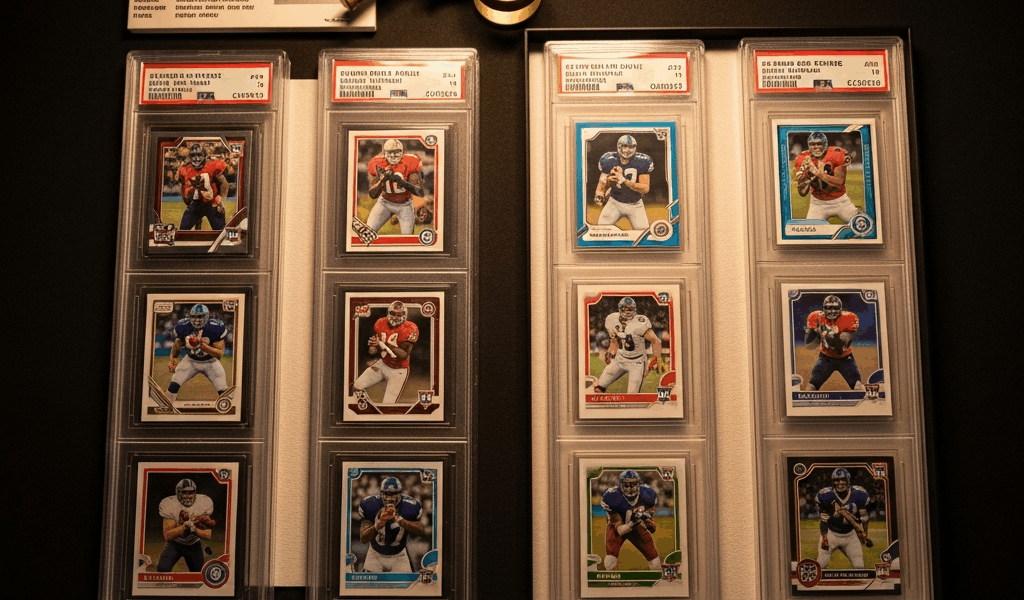
Rookie card collecting has gotten complicated with all the hype and misinformation flying around. I’ve watched collectors drop hundreds on a glossy rookie only to see it crater within two years. That stings — especially when it was avoidable. The difference between a card that holds ground and one that evaporates rarely comes down to how hot the player is right now. It comes down to three things: print run scarcity, set prestige, and grading potential.
First-year issue status matters more than most people admit. The card has to come from the player’s actual rookie season — not a prospect card, not some minor league release from two years prior. Then you look at the specific product. A rookie auto numbered to 99 copies ages completely differently than a base rookie pulled from a 2024 Topps Chrome blaster at Target. Numbered parallels, especially anything under /49, create a kind of artificial scarcity that interacts powerfully with player performance over time. When a kid breaks out and becomes a sustained star, those low-print autos move. Base cards from prestigious sets like Prizm or Chrome sometimes hold too, because raw copies stay abundant enough for grading arbitrage — buy ungraded, send to PSA, sell graded, pocket the spread.
The sets themselves carry real historical weight. Bowman Chrome, Prizm, Select, and National Treasures have proven track records for rookie retention because collectors recognize them and keep coming back. Off-brand sets or one-off products almost never produce cards worth keeping long-term. That’s just the reality.
Rookie Autos with Low Print Runs Hold the Best
Here’s what actually moves value over years: numbered rookie autos from respected sets with print runs under 100. Ideally under 50.
Take a 2023 Panini Prizm Rookie Patch Auto numbered /49. Even if the player has a mediocre sophomore season, that card retains floor value because scarcity is baked in permanently. Only 49 exist — globally. Compare that to a base rookie from the same set, printed in the thousands. The auto doesn’t need the player to become an MVP. It needs him to become competent. Stay in the league, accumulate stats, make an All-Star game somewhere down the road. That’s a much lower bar than predicting outright stardom.
Flawless Rookie Patch Autos work the same way. National Treasures prints so conservatively that even a role player’s rookie auto numbered /10 holds value as long as he stays employed. I bought a 2021 NT rookie auto /25 of a backup offensive lineman for $180 — three years ago now. He’s been solid but completely unremarkable. The card currently trades for around $210. It didn’t moon. But it didn’t evaporate either. That’s honestly the goal more often than people realize.
The logic is straightforward: low print run plus consistent annual collector interest equals persistent bid support. When you own a card numbered to 35 copies, you own one of thirty-five pieces on the planet. Demand doesn’t need to spike dramatically. It just needs to exist at all.
This is exactly why buying rookie autos at peak hype is a trap. You want to buy after the player’s rookie year, when the hype has cooled and people are panic-selling. A rookie auto from Prizm that cost $400 in September might hit $280 by March. That’s your entry point. The card’s floor hasn’t changed — it’s still /75 or /99 — but the emotional premium has fully deflated. Buy the card, not the moment.
Base Rookies That Beat the Odds and Why
Base rookies are usually a losing game. Most tank. But some hold, and understanding why saves real money.
Probably should have opened with this section, honestly. A base rookie card holds value only when three conditions line up at the same time: the player became a sustained starter rather than a one-season flash, the card comes from a flagship set like Topps Chrome or Prizm, and raw copies are still plentiful enough to make grading worthwhile. When all three click, grading arbitrage actually works. You buy raw copies for $3–$8 each, send them to PSA or BGS in bulk — I usually do batches of at least thirty — and flip graded copies at $12–$25 depending on the grade. The spread covers grading fees and leaves actual profit behind.
The 2019 Daniel Jones rookie from Topps Chrome is a real example worth examining. Most collectors were lukewarm on him coming out of Duke. Base copies hung around $2–$4 through most of 2020. But he played consistently enough that collectors who’d already moved on didn’t want to buy back in at higher prices. Raw copies stayed abundant. Send fifty copies to grade, pull a solid stack of PSA 8s and 9s, and you could move them at a meaningful spread. That arbitrage required zero prediction about Jones becoming elite — just a reasonable assumption he’d remain a competent NFL starter. He was. The card worked.
Compare that to a 2020 base rookie of a defensive end who played two seasons and washed out. The player’s absence from the league kills any grading arbitrage completely. Nobody wants the raw card. Nobody wants the graded copy. It’s dead weight in your binder — literally a $2 card that costs $25 to grade and sells for $4. Don’t make my mistake on those.
Flagship matters because those sets carry consistent collector demand year after year regardless of roster turnover. A base rookie from a random 2023 product that Panini released once and quietly abandoned has no grading spread. There’s no proof of concept, no collector base, no reason to own it. Stick to Chrome, Prizm, and Select base rookies if you’re playing the grading angle. Everything else is speculation dressed up as collecting.
Sets That Consistently Produce Value-Holding Rookies
Not all sets are equal. History has clear winners — and it’s not particularly close.
- Prizm — Still the category standard by a wide margin. Distribution is controlled enough that base rookies retain some value, and numbered versions hold firmly across multiple years. The design doesn’t age badly. Collectors have recognized it for over a decade now, and that familiarity is itself a form of value.
- Topps Chrome — The refractor technology aged surprisingly well. Chrome rookies from 2015 still pull legitimate bid support on eBay. Base copies grade cleanly. The parallel structure — from base refractors to numbered Superfractors — creates real scarcity without resorting to gimmicks.
- Bowman Chrome — Print runs are tighter here than most people realize. A base Bowman Chrome rookie holds better than a comparable base Prizm because fewer copies exist in circulation. Prospect collectors buy these regardless of immediate player performance because they’re always hunting the next breakout star.
- Select — Underrated for long-term value, honestly. Select controls production tightly and releases fewer copies per player than Prizm does. Rookie autos from Select rarely flood secondary markets. I’ve owned three Select rookie autos over the past five years. All three appreciated or held flat. None of them tanked — not even the one whose player missed a full season with injury.
- National Treasures — The premium option. Print runs are so conservatively low that even mediocre rookies carry genuine floor value. Expect to pay $80–$150 per pack at retail, but rookie autos numbered under /10 rarely disappoint over a five-year hold. This is the set where a backup lineman’s auto at /25 returns $210 on a $180 buy-in.
These sets work because they’ve earned collector staying power through consistency. People buy them every year — new collectors, veteran collectors, investors. That steady demand creates the bid support that keeps rookie values from collapsing under their own weight.
Red Flags That Tell You a Rookie Card Will Drop
Avoiding landmines matters as much as picking winners. Maybe more.
Overpopulated base sets are the first trap. If a product released in heavy retail and wholesale volume — blaster boxes stacked at Walmart, case breaks flooding YouTube — base rookies will tank. Supply is effectively unlimited. Don’t touch base rookies from sets designed primarily for pack cracking and bulk breakers. Grading arbitrage becomes mathematically impossible when PSA population reports show 4,000 copies of the same card already graded.
Base rookies of players with flat stats are obvious losses, but people keep buying them anyway. Watch years two and three closely. If he’s a backup, a benchwarmer, or a rotational reserve with no visible trajectory upward, the card goes nowhere. The player needs sustained production — or at least demonstrated competence as a legitimate league contributor. That’s the minimum threshold.
Short-print gimmick cards without real scarcity are sneaky bad investments. A card labeled “1 of 1” but printed on cardboard so flimsy it won’t grade, or a parallel that nominally exists in 500 copies but feels artificially rare — these don’t hold value. Real scarcity is numbered low and fully verifiable. Fake scarcity is a marketing term Panini uses on products they know collectors will second-guess by January.
Buying at peak hype is the single most common way collectors wreck their portfolios. Every rookie gets a moment — NFL draft weekend, an insane opening-week performance, a viral highlight clip. That’s when everyone buys and prices spike to irrational levels. Then reality sets in. Wait four to six weeks. Let the panic sellers liquidate at a loss. Then evaluate whether the card has actual fundamentals behind it or whether it was just noise from a single game.
Check the print run. Verify the set. Watch the player’s trajectory over multiple seasons. Ignore the hype cycle — it’s designed to make you buy at exactly the wrong moment. Follow that framework consistently, and your portfolio will look dramatically different in five years than the guy who bought every trending rookie in September.


Stay in the loop
Get the latest collector sports world updates delivered to your inbox.