Why Storage Kills More Cards Than Bad Pulls
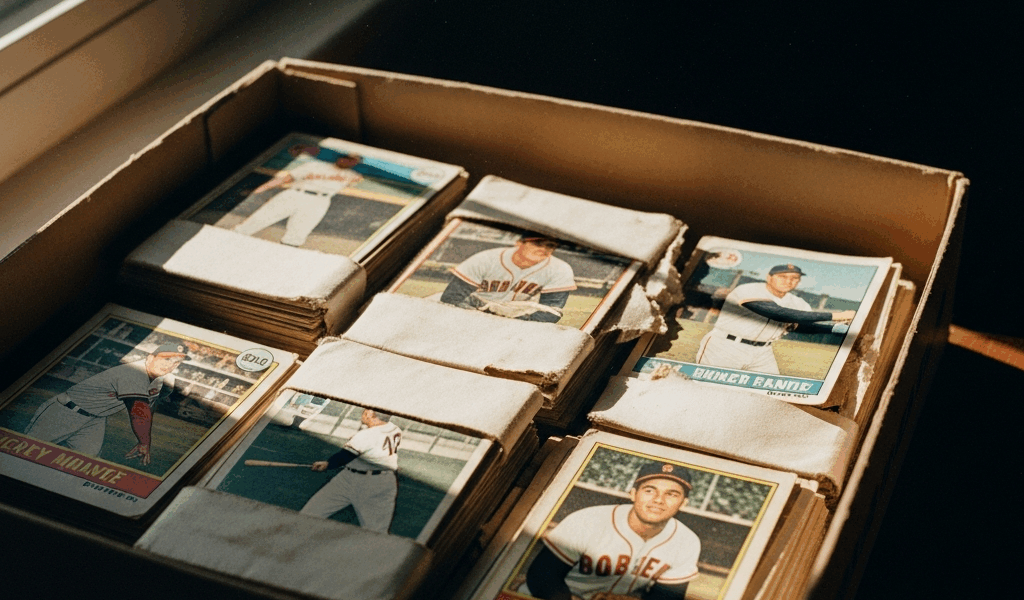
Sports card storage has gotten complicated with all the conflicting advice flying around. And honestly, most of the damage I see in collector communities has nothing to do with bad pulls or poor grading luck — it’s self-inflicted, slowly, invisibly, over months of careless storage.
Here’s a scene I keep watching play out in Facebook groups: someone posts a $200 card fresh from a PSA 9 grade. Another collector asks where they’re keeping it. The answer? Some variation of “bedroom closet, shoebox.” Six months later, that same person is confused about why their next submission came back a PSA 7.
The damage doesn’t announce itself. That’s the whole problem.
We obsess over condition at the moment of purchase — scrutinizing centering, corner sharpness, surface wear under a loupe before spending a dime. Then the card comes home and gets stored however feels convenient. You can buy a mint card and destroy it yourself within months. Humidity. Improper sleeving. Stacking. Light exposure. Some of that damage doesn’t even surface until a grader gets their hands on it.
Probably should have opened with this section, honestly. I had a 1986 Fleer Jordan rookie sitting in a penny sleeve, stacked with other cards on a bedroom shelf about fourteen inches from a window. Two years later, I pulled it out. Bottom corner had softened from moisture. Colors along the right edge had visibly faded. The card had warped just enough to catch light at an angle when you tilted it. What should have graded PSA 8 came back a 6. In that market, that’s the difference between $800 and $200. Don’t make my mistake.
Invisible damage compounds fast. You need a storage system that handles humidity, heat, light, and mechanical stress — not in theory, in actual practice.
Stacking Cards Without Proper Support
Stacking raw cards feels harmless. You’re not doing anything aggressive. They’re just sitting there in a neat pile.
But here’s what’s actually happening: every card supports the full weight of everything above it. The bottom card bears the entire load. Corners compress. Edges curve inward. Over weeks, that compression becomes permanent — the card doesn’t bounce back when you pull it out.
Face-to-face stacking is worse. The glossy back of one card presses directly against the print surface of the next. In any humid environment, cardboard swells unevenly. Some areas grip tighter than others. Pull the top card and you might find faint marks or dull spots exactly where the pressure peaked.
Penny sleeves alone don’t solve this — and I see collectors make this mistake constantly. Slide a card into a penny sleeve, call it done. A penny sleeve is plastic with zero structural integrity. It flexes with the card inside it. Stack ten penny-sleeved cards and you’ve essentially stacked ten unprotected cards with added friction between them. The sleeve absorbs no weight. It prevents no corner compression.
The correct pairing is penny sleeve plus rigid outer shell. A top loader, a Card Saver 1 (roughly $0.35–$0.50 each), or any comparable hard case transforms the situation entirely. Now the card sits in a sleeve, and that whole assembly slides into a hard plastic holder that won’t flex under pressure. The rigid holder distributes weight across its full surface. A stack of top-loaded cards can handle real weight without corner damage accumulating underneath.
Short-term stacking — a few days while you’re sorting and organizing — carries minimal risk. Long-term stacking is where things go wrong quietly. Cards stored that way for years will show measurable wear that graders catch immediately.
Humidity and Heat Warp Cards Faster Than You Think
Cardboard absorbs moisture from the air. It expands. But not evenly — the back coating is different from the front, edges absorb faster than the center, and that uneven expansion creates internal stress. The card warps. And a warped card is nearly impossible to recover. Dry it out, and the warp usually stays anyway. A PSA grader will dock points for curvature. Severe warping rules out a 9 or 10 entirely, regardless of surface condition.
The worst storage locations are almost obvious in hindsight: basements, attics, garages, spaces near windows or exterior doors. Basements run consistently damp — humidity levels can spike to 60, 70, even 80 percent relative humidity in older homes. Attics cook in summer, condense moisture in winter. Garages sit uninsulated and exposed to whatever the weather outside is doing. Window proximity means temperature swings and the possibility of direct sunlight hitting cards you forgot were even there.
The target range for card storage is roughly 40–50 percent relative humidity and 65–70 degrees Fahrenheit. That’s not hard to achieve in a climate-controlled bedroom closet or living room. It’s nearly impossible in an unfinished basement without active dehumidification running.
If a climate-controlled space isn’t available, use silica gel packets inside your storage boxes. Rechargeable packets run about $15 for a pack of five and will pull moisture from an enclosed box for months. Small plug-in dehumidifiers built for closets cost $50–$100 and handle larger collections. I’m apparently sensitive to humidity and the Govee monitor I picked up for $20 changed how I thought about storage — cheap insurance against hundreds of dollars in avoidable damage.
UV Light Fades Color on Chrome and Holo Cards
Sunlight and fluorescent light both carry ultraviolet radiation. UV exposure degrades the chemical bonds in card ink and foil layers. The damage is cumulative. It’s permanent.
Chrome cards and refractors are especially vulnerable — the foil layer is essentially the entire point of those cards visually. When UV fades that foil, the card’s appeal just dissolves. A 1997 Bowman Chrome refractor stored on a bright windowsill for a year can look like a heavily used copy despite flawless corners and edges. The foil is washed out. Graders notice. Points come off.
Common mistakes collectors make: displaying raw cards on open shelves near windows, keeping cards in clear plastic boxes that sit in sunlight, using display cases without UV-filtering acrylic, and stacking cards next to desk lamps or under the fluorescent shop lights running in garage setups. That last one comes up more than you’d expect.
For long-term storage, the answer is simply opacity. Opaque plastic storage boxes cost $3–$8. Once cards are inside, no light reaches them. You lose the daily visual satisfaction of seeing your collection — but your cards stay protected. If display matters to you, invest in UV-blocking cases, which start around $40 for small display stands. That’s not a huge spend against the value of what you’re showing off. For casual storage, though, store dark and display occasionally. That’s the practical approach.
The Penny Sleeve Mistakes Most Collectors Make
Forcing a card into a penny sleeve at an angle is mistake number one. The corner catches the sleeve opening. You push a little harder. The corner bends. That damage happens in one second and you don’t see it until the card is already inside. Correct technique is straightforward: open the sleeve fully, align the card straight, slide it in with the open end facing up. No force required. Ever.
Stretched-out sleeves are the second problem. After months of use, the sleeve mouth widens and stops gripping the card. The card shifts inside. Movement creates friction — friction causes surface scuffing. Buy fresh sleeves regularly. Old ones go in the trash, not back in rotation.
Double-sleeving incorrectly is number three. Some collectors put a card in a penny sleeve, then slide that whole assembly into another penny sleeve for “extra protection.” The inner sleeve folds. The outer sleeve presses against the folded section. You’ve created uneven pressure in a confined space — the opposite of what you wanted. If you’re going to double-sleeve at all, use a penny sleeve plus a slightly roomier soft sleeve, not penny-on-penny.
Off-brand penny sleeves are a quieter issue. Some have coatings or plasticizers that degrade over time. The sleeve turns sticky, adheres to the card’s print surface, and removing it causes damage. I’m apparently a brand loyalist about this — Ultra Pro and Beckett penny sleeves both work well for me while off-brand options have never worked the way I needed. They cost a fraction of a cent more per sleeve and eliminate the problem entirely.
The correct sequence is simple. Penny sleeve, open end facing up. Then into a hard outer holder — top loader or Card Saver 1. That assembly goes into an opaque storage box kept in a climate-controlled room. No excessive weight stacked on top. No light. No moisture. That’s it. So, without further ado, go check whatever shoebox or shelf your cards are sitting on right now — and fix it before the next grading submission tells you what you missed.

Stay in the loop
Get the latest collector sports world updates delivered to your inbox.