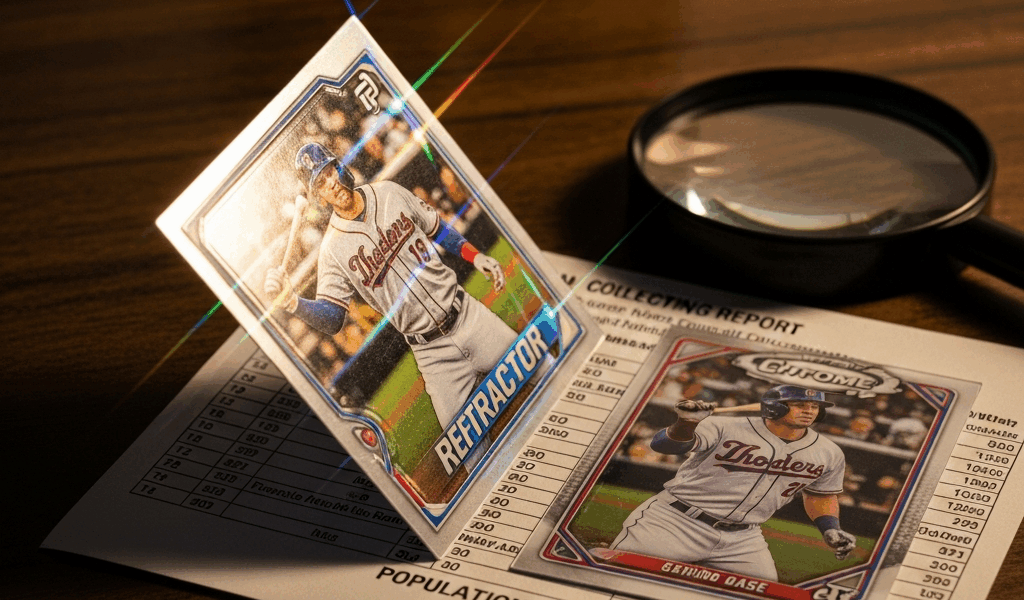
Refractor vs Chrome Cards — Which One Holds Value
Refractor vs chrome cards has gotten complicated with all the misinformation flying around — especially on forums where everyone’s suddenly an expert. As someone who’s been digging through hobby boxes and watching eBay auctions tick down to zero for about eight years, I learned everything there is to know about what separates these two card types. Today, I will share it all with you.
I made the rookie mistake of treating every shiny card the same. Cost me real money — probably $400 or $500 across my first two years before I wised up. Once I understood what a refractor actually does at resale versus a chrome base card, everything changed.
What Actually Makes a Card a Refractor
But what is a refractor? In essence, it’s a finish type applied to the same cardstock used for chrome base cards. But it’s much more than that.
A refractor is not a separate product line. That trips people up constantly. The difference is a treatment applied during manufacturing — a light diffraction pattern gets baked into the surface. Tilt the card under a lamp and you see a rainbow wave moving across it. Almost like an oil slick. Chrome base cards are also shiny, sure. But the refractor throws actual color. That prismatic shift is unmistakable once you’ve held both types in the same hand.
Spotting one is easy. Grab a Topps Chrome base card and a refractor of the same player, put them side by side. The base chrome reflects light consistently across the whole surface. The refractor moves. Not every glossy card is a refractor — and this matters badly when you’re buying raw cards in bulk lots where the seller just says “shiny.”
Refractors also exist across multiple color variants. Base refractors carry no print run. Then you’ve got blue refractors, gold refractors numbered to /50, orange to /25, red to /5, and the superfractor sitting alone at 1/1. The diffraction finish stays consistent across all of them. What changes is the color tint and how many exist.
Chrome Base vs Refractor Pricing at a Glance
Probably should have opened with this section, honestly. These numbers make everything else click immediately.
Take a 2022 Topps Chrome Julio Rodriguez rookie card. Raw, ungraded chrome base copies were moving between $8 and $15 on eBay through most of 2023. A raw base refractor of the same card? Somewhere between $35 and $60 depending on centering. That’s a 3x to 4x gap on a completely raw card — same player, same year, same set.
Push it further. A PSA 10 chrome base Julio Rodriguez rookie sits around $40 to $60 graded. A PSA 10 base refractor? Closer to $150 to $200 on a good day, sometimes higher when two motivated buyers meet in the same auction. Gold refractors numbered /50 have cleared $500 raw when the market was running hot. The gap widens fast once serialization enters the conversation.
Why Refractors Consistently Outsell Chrome Base
Scarcity is the first reason. Base chrome cards get printed in massive quantities. Refractors — while not serialized at the base level — come out of hobby boxes at roughly 1-in-4 or 1-in-5 pull rates, depending on the product. Topps has never published exact print run numbers for base refractors, but the market has priced the scarcity accurately for years.
Then there’s the rainbow chasing community. Rainbow chasers pursue every parallel of a single player’s card from a given set — and they need the base refractor to complete the run. That demand floor doesn’t disappear during a cold stretch. It’s structural. Someone is always building that rainbow, and they’ll pay for whatever piece they’re missing. That’s what makes refractors endearing to us collectors — the built-in, persistent buyer base that chrome base simply doesn’t have.
Population reports on PSA and BGS amplify all of this. Pull up a mid-tier prospect’s refractor and you might see 12 PSA 10s in existence. Twelve. The chrome base version of that same card might show 200-plus PSA 10s. That supply difference hammers per-card value in a way that’s easy to calculate and hard to argue with.
Refractors win this comparison. The diffraction finish is harder to keep pristine, PSA 10 grades are harder to achieve, and rainbow builders create a persistent bid that doesn’t go away. Numbered parallels don’t just continue that trend — they accelerate it.
When Chrome Base Cards Are the Better Buy
Chrome base deserves a fair look here. This is actually where budget collectors and volume flippers should pay close attention — at least if they’re working with under $200 per session at shows.
I’m apparently a compulsive batch tester and BGS works for me while PSA grading timelines never worked for my patience. Don’t make my mistake of defaulting to one grading company without running the numbers on both. That said — I bought 40 raw chrome base rookies from the 2021 Bowman Chrome set for roughly $2.50 to $4 each, graded the best-looking ones, and turned several high-grade copies around for $20 to $30 each. Not life-changing. But a consistent 5x to 8x return on specific cards where the population report was thin.
Chrome base also grades more forgivingly than refractors in one specific way. The diffraction surface on a refractor catches every handling mark and print line. Chrome base is more forgiving — higher yield rates when you’re submitting a batch of 15 or 20 cards.
For flipping commons at a show or moving bulk lots, chrome base is more liquid. Buyers comfortable spending $5 to $15 are everywhere. Buyers ready to drop $150 on a single raw refractor are considerably fewer. Volume flippers move faster with chrome base. Simple math.
Which One Should You Actually Chase
So, without further ado, let’s dive in on the actual breakdown — because the answer depends entirely on what you’re doing with the card.
- Flipping for profit on a budget — Chrome base, low pop PSA 10 candidates, prospects trending upward. Buy raw at $3 to $6, grade selectively, move quickly before the prospect cools off.
- Long-term holds on star players — Base refractors and numbered parallels. Scarcity holds through market cycles in a way that chrome base simply doesn’t.
- Set building on a budget — Chrome base every time. Refractors will blow your budget before you finish half the checklist.
- High-end single card investment — Numbered refractors only, ideally /50 or lower, PSA 10 or BGS 9.5, top prospects or proven stars with staying power.
That diffraction pattern on a refractor isn’t just visual flair. It signals that the card came out of a lower-yield production process, that fewer exist in the world, and that collectors with real money will compete hard for the best copies. Chrome base is the entry point. Refractors are where the value lives. If you’re standing at a card show with $100 in your pocket, one sharp refractor of the right player beats ten chrome base cards of the same guy — almost every single time.


Stay in the loop
Get the latest collector sports world updates delivered to your inbox.