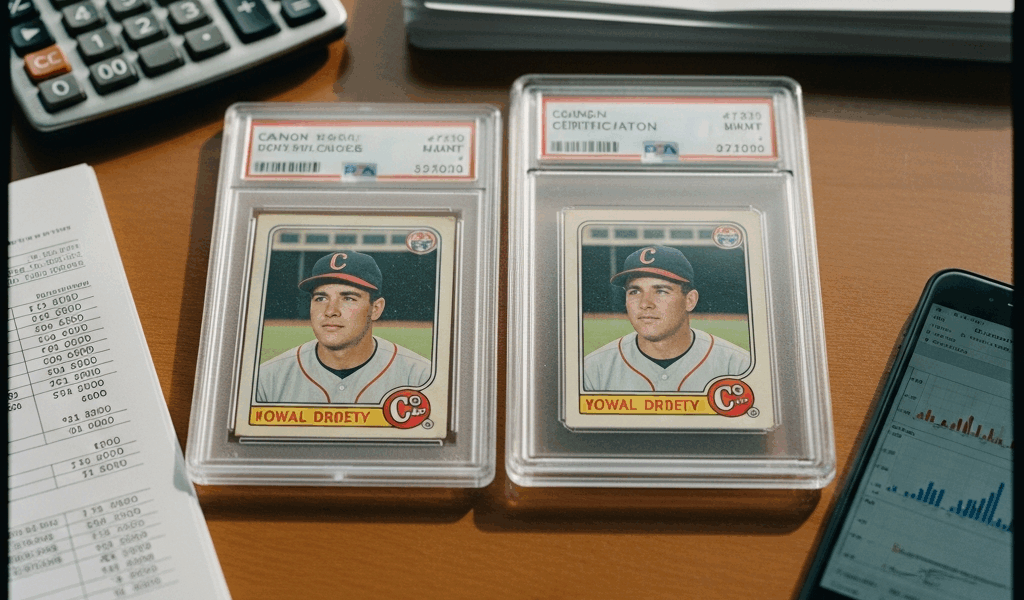
Raw vs Graded Cards — Which One Should You Sell
Why This Decision Matters More Than Most Collectors Think
The raw vs graded cards debate has gotten complicated with all the conflicting advice flying around. As someone who has been buying, selling, and occasionally losing sleep over card decisions for about eleven years, I learned everything there is to know about this particular fork in the road. Today, I will share it all with you.
Here’s the thing nobody says out loud: grading feels responsible. It feels like the move a serious collector makes — protective, legitimate, professional. But it’s also a bet. You’re wagering that the fees pan out, that the grade comes back strong, that the market still cares about this card in four months. And that a PSA population report doesn’t get flooded while your submission sits in a vault in Santa Ana, California.
Sometimes the bet pays off. Sometimes you get a PSA 7 back on a card you were dead certain was a 9, and the graded value sits lower than what you could have gotten selling it raw the week you pulled it. That stings in a specific way. I know because it happened with a 2018 Topps Chrome Shohei Ohtani rookie I sent in during his first MVP season. Got it back five months later. Hype had cooled. The PSA 8 I received wasn’t moving anyone. Sold it for $12 more than raw copies were fetching — after $22 in fees.
The math is not always on grading’s side. That’s the whole point.
When Selling Raw Cards Actually Makes You More Money
Burned by the Ohtani situation, I started running real numbers before every submission. What I found surprised me — at least if you’ve been operating on gut instinct like I was.
Low-value cards are the obvious starting point. If a card moves raw for $35 to $40 on eBay, grading it almost never pencils out. PSA’s Economy tier runs $25 per card plus shipping both ways — call it $30 to $35 all in. On a $40 card, a PSA 9 might fetch you $55 on a good day. That’s a $15 gain against $30 in costs. The rough threshold I use personally: if the raw sale price is under $40, fees eat the margin unless you have serious reason to expect a PSA 10.
Hot-market windows are the second scenario. Player gets traded to a big-market team. Hits a milestone. Gets nominated for an award. These spikes are real — but short. Sometimes two or three weeks, tops. Submitting during a spike means the card ships back to you after the spike ends. Selling raw the day the news breaks is almost always the better play. Don’t make my mistake of chasing the moment with a submission form.
Then there are cards with visible issues you already know about. Slight off-centering that isn’t egregious. A tiny surface scratch visible only at an angle under direct light. Always describe condition accurately — that part isn’t negotiable. But a card a buyer might accept at a fair raw price could easily come back a PSA 6 and be worth less graded than ungraded. Know your card’s flaws before you ship it anywhere.
When Graded Cards Win at the Sale
Grading absolutely earns its keep in specific situations. The mistake most collectors make is treating those situations as the default instead of the exception.
But what is a graded card’s real advantage? In essence, it’s third-party verified condition in a tamper-evident case. But it’s much more than that — it’s a pricing tier shift, and that only matters when the tier gap is large enough to justify the cost and the wait.
Rookie cards of active stars where a PSA 9 or 10 creates a genuinely different price bracket are the clearest win. A 2020 Topps Chrome Julio Rodriguez base rookie moves raw for around $15 to $20 depending on condition. A PSA 10 sells for $80 to $100. That’s a tier, not a nudge. The math works — at least if you’re confident in the card’s condition before you commit to the submission.
Vintage cards are the other strong case. Pre-1980 cards make buyers nervous when they’re ungraded. Trimming, restoration, surface cleaning — it’s all on the table in buyers’ minds. A raw 1967 Topps Tom Seaver in apparent VG condition leaves room for doubt. A PSA 4 removes that doubt and typically commands a real premium over what a raw copy fetches, even after fees. Authentication matters as much as the actual grade in vintage. That’s what makes graded vintage endearing to us older set collectors.
High-value modern cards also benefit — but only when the PSA population report isn’t already flooded. Pull up the pop report before you submit anything. If there are 4,000 PSA 10s of a card already sitting in circulation, your PSA 10 is not scarce. It’s just another slab in a crowded room. Check the pop. This step takes two minutes and it changes everything.
The Fees and Timeline That Change the Math
Probably should have opened with this section, honestly, because the numbers reset every assumption you’re carrying.
PSA’s current Economy tier runs $25 per card with stated turnaround times of roughly 100 business days — that’s five calendar months, give or take. Their Value tier is $50 per card with a faster window. The Regular tier sits at $100. None of the budget options are quick. These are not 2019 numbers. The pandemic-era backlog broke collector expectations permanently, and even now, cheap-tier submissions take serious time.
I’m apparently a slow learner on this front, and the Economy tier works for me financially while the time cost never quite registers until it’s too late. Five months is a long time in a market driven entirely by player performance. A quarterback prospect submitted in October might be a genuine bust by March. A soccer player riding Champions League hype in May might be completely forgotten by November.
Frustrated by a stretch of bad timing calls, I started tracking every submission against the market window I had when I sent it in — using nothing more sophisticated than a $3 notebook from CVS. The pattern was ugly. Cards submitted during peak moments came back in off-peak moments, consistently. Time in grading is time the card is not generating revenue. That opportunity cost is real, and it almost never shows up in the comparisons people post online between raw and graded sale prices.
A Simple Framework for Making the Call
So, without further ado, let’s dive in — because this is the part that actually changes how you operate.
Before any submission, I ask three questions. If I can’t answer yes to all three, the card gets sold raw. No debate, no second-guessing.
- What is the raw sale price right now — today, not three months ago? Pull three recent eBay sold listings. Get a real number. Comps from last quarter are fiction at this point.
- Does a PSA 9 or 10 meaningfully change that number? Not a little — meaningfully. At least close to double the raw price to justify the fees and the wait. A $5 bump on a $40 card is not meaningful.
- Can you afford to wait four to six months without that sale? Financially, sure, but also in terms of market timing. Is this player’s value tied to an active season or a hype cycle that could fade before your slab comes back?
Raw might be the best option for most cards you’re holding, as the selling process requires honest math — not optimism. That is because the grading premium only materializes under specific conditions, and those conditions are rarer than the hobby’s loudest voices suggest.
If the raw price clears the fee threshold, the graded premium is real and documented, and the wait won’t hurt you — submit it. That’s a PSA card. If even one of those answers gets shaky, sell raw now and move on. The collectors I’ve watched make consistent money aren’t the ones grading everything. They’re the ones who grade selectively and sell raw without ego when the numbers point that way. Raw isn’t settling. Sometimes raw is just the smarter trade.

Stay in the loop
Get the latest collector sports world updates delivered to your inbox.