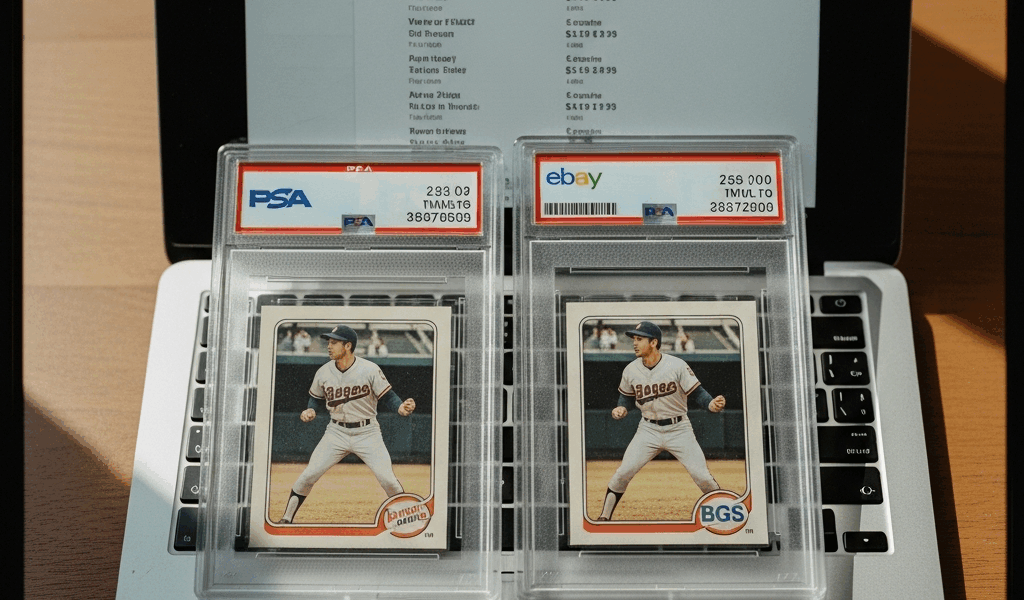
PSA vs BGS — Which Grading Service Gets You More Money
Why the Slab Brand Changes What Buyers Will Pay
The PSA vs BGS debate has gotten complicated with all the conflicting advice flying around. As someone who submitted 23 cards to BGS back in 2021 and watched several of them sit unsold for weeks while identical PSA copies moved in under 48 hours, I learned everything there is to know about how slab brand affects your wallet. Today, I will share it all with you.
Same cards. Same numeric grades. Different slabs. Completely different outcomes — and that distinction cost me real money before I finally paid attention. Here is the example that made it impossible to ignore. A 2017 Panini Prizm Patrick Mahomes rookie PSA 10 was clearing around $650 on eBay in late 2022. A BGS 9.5 of that exact same card — a grade many collectors consider harder to earn, by the way — was moving between $280 and $320. That is not a rounding error. That is a fundamentally different financial decision, and it has nothing to do with which company grades more accurately.
But what is slab brand value, exactly? In essence, it’s the market premium attached to the holder itself, independent of the grade inside. But it’s much more than that. Buyers are purchasing liquidity, familiarity, and in some cases the specific collector culture wrapped around that particular holder. That’s what makes this whole conversation endearing to us collectors — it’s never really just about the number on the label.
Where PSA Commands a Higher Price on Resale
For modern rookies and high-volume mainstream sets, PSA 10 is the dominant currency. Full stop. A 2020 Topps Chrome Julio Jones rookie, a 2021 Prizm Trevor Lawrence, honestly almost anything from a major Topps or Panini release in the last decade — PSA 10 is what the bulk of buyers are actually searching for on eBay. The completed sales data reflects this even harder than the search volume does.
Pulled from recent eBay sold listings: a PSA 10 2018 Panini National Treasures Luka Doncic rookie was fetching between $4,200 and $4,800 depending on the week. BGS 9.5 versions of that same card were landing closer to $2,800 to $3,100. That’s a 40 to 50 percent premium for the PSA slab — not because PSA grades more strictly. BGS is arguably tougher on centering. It comes down to buyer behavior, familiarity, and the sheer volume of PSA slabs already circulating in the market.
PSA also wins on speed. Most PSA 10 modern cards move faster than BGS equivalents — at least if you care about turnover rather than just final sale price. A card sitting in your inventory for six extra weeks waiting for the right BGS buyer is a real cost, even when the eventual number looks comparable on paper.
- Modern rookies from NFL, NBA, MLB mainstream sets — PSA 10 wins on both price and velocity
- Pokemon base set holos — PSA 10 dominates resale across most price ranges
- High-profile sports cards under $500 raw — PSA 10 buyer pool is significantly larger
- Any card where casual collectors are the likely buyer — PSA is the recognizable name
Where BGS Slabs Actually Win the Price Battle
Probably should have opened with this section, honestly, because it’s the one most comparison articles completely skip. BGS does win — in specific, well-defined situations that require actually knowing your buyer.
The BGS 9.5 Black Label is the clearest example. Every single subgrade — centering, corners, edges, surface — has to hit a 9.5 for that designation. Exceptionally rare. For certain vintage cards and high-end modern parallels, a Black Label commands a premium over even PSA 10, because the collector hunting for one is specifically after documented perfection across all four categories. A 2003 Topps Chrome LeBron James rookie BGS 9.5 Black Label has cleared above PSA 10 prices in multiple recorded transactions. That is not an accident.
Vintage material is the second major BGS advantage. Collectors working in pre-1980 territory often prefer BGS because subgrades give them more usable information. A BGS 8 on a 1952 Topps Mickey Mantle tells a serious buyer whether the grade dropped from centering or corners — and that distinction matters enormously for targeted collections. That transparency produces a buyer willing to pay more for the BGS slab even at lower grade tiers.
Autograph cards round out the third category. BGS grades the signature separately, producing an auto grade alongside the card grade. A BGS 9.5/10 means the card itself graded 9.5 and the signature graded a 10. For autograph-focused collectors who treat the signature as the primary asset — not secondary decoration — that credentialing carries real monetary weight.
- BGS 9.5 Black Labels on premium cards — can exceed PSA 10 prices in the right market
- Vintage pre-1980 cards — subgrades add measurable value for serious set collectors
- Autographed cards where signature quality drives the purchase decision
- High-end investors who want documented subgrade breakdowns for resale transparency
Submission Cost vs Return — When the Math Actually Works
Current standard tier grading at PSA runs $25 per card for anything valued under $499, with roughly a 45 to 65 business day turnaround as of early 2024. BGS standard tier sits at $22 per card with comparable windows. The $3 difference is basically noise — it should never be the variable driving your submission decision. Expected sale price absolutely should be.
So, without further ado, here is the math on a real modern rookie example. A raw Ja Morant 2019 Panini Prizm base rookie in near-mint shape runs about $60 to $80 on the open market. PSA 10 copies of that same card have been selling for $180 to $220. BGS 9.5 copies are moving at $90 to $120. Submit to PSA at $25, pull a 10, sell for $195. Net gain over raw: roughly $110 after fees. Submit to BGS at $22, pull a 9.5, sell for $105. Net gain over raw: roughly $23 after fees. Same card. Same physical quality, approximately. Completely different math.
I’m apparently a slow learner — BGS works for me on vintage and auto material while PSA never disappoints on modern rookies. Don’t make my mistake. The submission fee is almost never the variable that matters. Grade tier and slab brand together determine whether you made money or just broke even on something that was already worth something raw.
Which Service to Pick Based on What You Are Selling
Here is the direct answer — at least if you want to skip the hedging and get to the part that actually helps.
Submit modern rookies, mainstream sports sets, and Pokemon to PSA. Larger buyer pool. Higher prices. Faster movement. Anything from the last 15 years in a mainstream release, PSA 10 is the target. That was true in 2021 and it’s still true now.
Submit vintage cards, autograph-heavy material, and anything where subgrade transparency will drive a premium to BGS. If your buyer is a specialist — a set collector, a vintage dealer, an autograph-first collector — BGS hands them more information and they will pay for it. That information asymmetry is where BGS earns its place.
Do not submit lower-value cards to either service. A raw card worth $15 to $25 does not justify a $22 to $25 grading fee plus two-directional shipping plus two months of waiting. The math doesn’t work at that tier regardless of which company ends up holding the slab. Sell it raw and keep the fee — honestly, that’s the whole lesson right there.
This new tiered approach to submission decisions took off several years into the hobby’s modern boom and eventually evolved into the framework serious flippers know and rely on today. Modern and mainstream — go PSA. Vintage, autos, and niche specialist markets — BGS earns its place. Everything else — sell raw and move on.

Stay in the loop
Get the latest collector sports world updates delivered to your inbox.