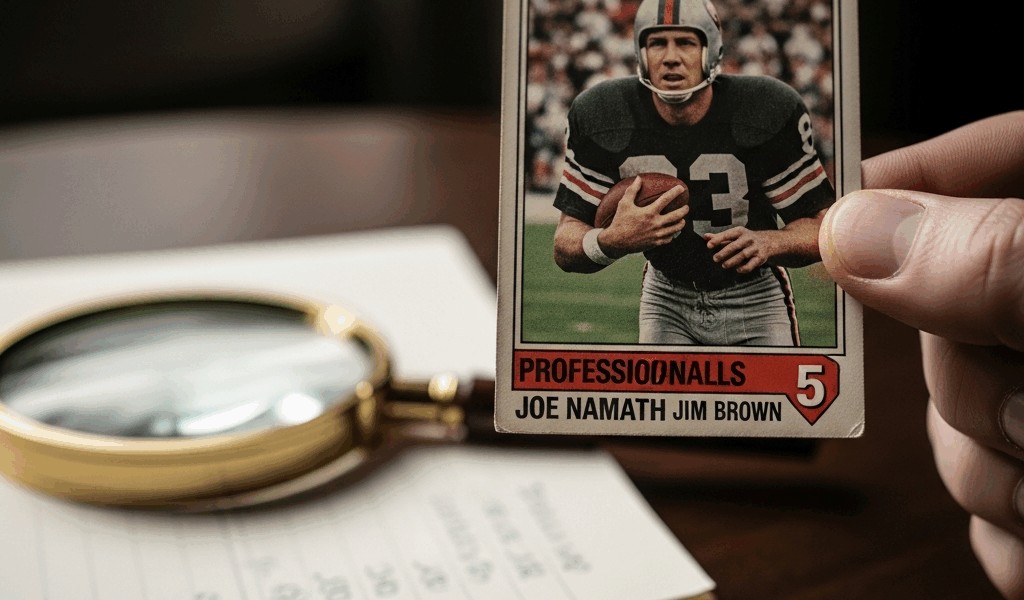
Most Valuable Football Cards of All Time — Prices and What to Look For
Football cards have gotten complicated with all the misinformation flying around about what’s actually worth chasing. I say that as someone who’s spent fifteen years buying, selling, and occasionally weeping over cardboard — I learned everything there is to know about this market the hard way. A 1935 National Chicle Bronko Nagurski PSA 8 crossed $900,000 at auction while I stood there doing mental math on my retirement account. Football cards don’t get the breathless mainstream press that baseball cards do. Collectors have known this forever. But the ceiling on graded, high-condition football paper? Genuinely staggering.

I got into football cards seriously around 2009 — mostly through stupidity, honestly. I sold a PSA 7 Jim Brown rookie for $400 because that felt like real money at the time. It later hammered for over $4,000 at auction. Don’t make my mistake. The education cost me plenty, but here’s what that tuition bought.
The All-Time Most Valuable Football Cards
These are the cards that define the ceiling of the hobby, ranked by most recent confirmed sale price. Prices shift — sometimes dramatically — based on who’s bidding, what grade a card holds, and whatever’s happening in the broader economy. The figures below reflect the most recent publicly documented sales as of 2024.
-
1935 National Chicle Bronko Nagurski — Card #34
Player: Bronko Nagurski | Year: 1935 | Condition: PSA 8 | Most Recent Sale: ~$900,000
This is the white whale. Nagurski was the dominant force in early professional football — a fullback who apparently ran through defenders rather than around them — and this card from the National Chicle set is universally considered the most important football card ever printed. The set itself was designed to compete with Goudey baseball cards, and Nagurski anchored the whole thing. High-grade copies are extraordinarily rare. Centering problems and brittle paper stock from the era mean most copies never crack PSA 5. A PSA 8 is basically a small museum artifact that lives in a top-loader.
-
1958 Topps Jim Brown — Card #62, Rookie
Player: Jim Brown | Year: 1958 | Condition: PSA 9 | Most Recent Sale: ~$358,000
Brown’s rookie card in PSA 9 is the benchmark for postwar football cards. Widely regarded as the greatest running back in NFL history, his 1958 Topps issue — his only major mainstream rookie — reflects that legacy directly in the price. PSA 9s are exceptionally hard to locate. Toning and print quality problems baked into the production process make high grades nearly impossible to pull.
-
2000 Playoff Contenders Championship Ticket Tom Brady — Rookie Autograph
Player: Tom Brady | Year: 2000 | Condition: BGS 9.5/Auto 10 | Most Recent Sale: ~$3,107,852 (2021)
The modern record holder. Brady’s Championship Ticket auto from Playoff Contenders is numbered to just 100, and the combination of genuine scarcity, Brady’s unmatched career résumé, and the explosive 2020–2022 card market drove one copy past three million dollars. BGS 9.5 with a BGS Auto 10 subgrade — that’s the specific grade combination serious collectors hunt for on this card. Everything else is a consolation prize by comparison.
-
1957 Topps Johnny Unitas — Rookie Card
Player: Johnny Unitas | Year: 1957 | Condition: PSA 9 | Most Recent Sale: ~$400,000+
Unitas cards in PSA 9 are among the rarest vintage football cards on the market, period. The 1957 Topps set was prone to off-center printing and rough edges straight from the factory — not collector damage, just shoddy 1950s production. His impact on the quarterback position, and on how the game itself gets televised and understood, makes this card historically significant well outside the narrow world of card collecting.
-
2018 National Treasures Patrick Mahomes — Rookie Patch Autograph /99
Player: Patrick Mahomes | Year: 2018 | Condition: PSA 10 | Most Recent Sale: ~$861,000
Mahomes is the active player most collectors are currently building around. His National Treasures RPA — rookie patch autograph, numbered to 99 — is the key modern card. High PSA grades on patch autos are genuinely difficult to achieve given the card construction. Thick card stock triggers mechanical centering problems at grading scale. A PSA 10 on this card is a real accomplishment.
-
1965 Topps Joe Namath — Rookie Card #122
Player: Joe Namath | Year: 1965 | Condition: PSA 8 | Most Recent Sale: ~$150,000+
Broadway Joe’s rookie card is a staple of serious vintage collections. The yellow border is the problem — any chipping or corner wear drops the grade fast, and that border chips if you breathe on it wrong. PSA 8s are real money. PSA 9s of this card are effectively nonexistent in the marketplace. I’ve spoken to dealers who have never handled one in person.
-
1976 Topps Walter Payton — Rookie Card
Payton’s most collectible cards come from the 1976 Topps set — his true rookie. PSA 9 copies have sold in the $13,000–$18,000 range, which puts him outside the top five on pure price but firmly in significant vintage territory. The 1976 set had better print quality than most football issues of the era, which means high grades exist. They’re just hard to find and expensive when they surface.
-
1986 Topps Jerry Rice — Rookie Card #161
Player: Jerry Rice | Year: 1986 | Condition: PSA 10 | Most Recent Sale: ~$14,000–$22,000
Rice’s 1986 Topps rookie is one of the most recognized football cards in the hobby — full stop. PSA 10s exist in meaningful quantities compared to vintage cards. “Meaningful quantities” still means roughly 1–2% of all submissions, though. Centering and surface issues on the 1986 Topps set are brutal. I’ve pulled cards from unopened packs that wouldn’t grade above a 7.
-
2000 SP Authentic Tom Brady — Rookie Card /1250
Player: Tom Brady | Year: 2000 | Condition: PSA 10 | Most Recent Sale: ~$900,000
The more accessible Brady rookie — numbered to 1,250 rather than 100 — still commands extraordinary prices in PSA 10. This is what most collectors call “the Brady rookie” because it’s the most widely recognized version. Don’t confuse it with the Playoff Contenders auto, which is rarer and considerably more expensive. They’re related but they’re not the same conversation.
Vintage Football Cards That Command Premiums
Probably should have opened with this section, honestly. Without understanding what makes vintage cards valuable, those price tags above look completely random. They’re not. There’s an internal logic to this market — once you see it, you can’t unsee it.
The 1935 National Chicle Set — Why It Defines the Hobby
Frustrated by a boring Saturday, I let a friend drag me to a card show in Chicago back in 2010 — he collected stamps, of all things, and thought I’d find it interesting. I found a National Chicle Nagurski behind glass and assumed someone had written the price tag incorrectly. The set was issued by the National Chicle Company of Cambridge, Massachusetts — the same outfit that made Sky Bird gum and other Depression-era confections sold for a penny at corner stores. The football cards were designed to replicate the commercial success of Goudey’s baseball line, which was moving well despite the economic collapse happening everywhere around them.
The Nagurski card measures the standard 2⅜ × 2⅞ inches. The artwork is hand-painted — there are no photographs anywhere in the set, just illustrated portraits against color backgrounds that vary throughout. What makes the card scarce isn’t just its age. The cardboard stock from 1935 was thinner and more brittle than later issues, and it shows. Most surviving copies carry corner wear, paper loss, or creasing significant enough to tank the grade. A PSA 7 Nagurski is a legitimately impressive card to own. A PSA 8 is a trophy.
The other cards in the set — Beattie Feathers, Dutch Clark, Ken Strong — matter too, though none approach Nagurski’s value. Budget around $500 to $3,000 for other significant National Chicle cards in mid-grade, depending on the player.
The 1958 Topps Jim Brown — What to Know Before You Buy
Brown’s rookie card comes from the first year Topps produced a standalone football set after their shared licensing years. Card #62. The background is a sky blue that fades inconsistently in print — that’s normal production variation, not damage. The text on the back is brown ink on cream stock, and it’s usually the back that kills the grade: ink bleeding, paper texture variations, and print registration problems are everywhere on this set.
When buying raw — meaning ungraded — copies of this card, check four things in this order: corners first, because sharp corner tips in hand are genuinely encouraging. Then centering, since the left-right margin variance is the most common killer. Then surface under direct light held at an angle, looking for scratches or print artifacts. Then flip it over and check the back for staining. Staining on the back of 1958 Topps is extremely common — these cards spent thirty years rubber-banded in stacks in attics and basements.
A raw Jim Brown rookie in what looks like VG-EX condition is worth submitting for grading. PSA submission costs run $25–$150 per card depending on the service tier. The difference between a confirmed PSA 5 and a confirmed PSA 7 on this card is measured in thousands of dollars — the grading fee pays for itself fast.
1957 Topps — The Set That Defined a Decade
The 1957 Topps football set is where serious vintage collectors spend a disproportionate amount of time. Beyond Unitas, the set includes Bart Starr’s rookie card (#119) and Paul Hornung’s rookie. Starr’s PSA 9 sold for over $100,000 at Heritage Auctions in 2022. These players defined championship football through the 1960s, and their presence together in one set makes the 1957 Topps something of a landmark issue.
The set features a horizontal orientation for the player photos — unusual for the era — and a red border that chips aggressively. That’s what makes the 1957 Topps endearing to us collectors, and also what makes it maddening. A Unitas rookie that looks clean to the naked eye will often show micro-chips under a 10x loupe — chips that drop the grade by a full point. Always examine the border with magnification before committing to a raw purchase.
Modern Football Cards Worth Checking Your Collection For
The modern card market runs on different logic than vintage. Scarcity is manufactured through print runs, serial numbering, and tiered rarity systems. A card numbered /10 is worth more than the same card numbered /99, which is worth more than a base version with no numbering at all. This isn’t complicated — but plenty of collectors who grew up buying cards in the 1980s and 1990s haven’t fully adjusted to it, and they make expensive mistakes.
Tom Brady Rookies — The Hierarchy
Brady’s 2000 cards span multiple products, and not all of them carry equal weight. Here’s the basic hierarchy collectors use:
- 2000 Playoff Contenders Championship Ticket Auto /100 — The top tier. Three million dollars at peak. Still trades at $400,000–$600,000 in today’s more normalized market for high grades.
- 2000 SP Authentic /1250 — The most iconic non-auto Brady rookie. PSA 10 copies have sold above $900,000. PSA 9s move in the $50,000–$100,000 range.
- 2000 Topps Chrome Refractor — Numbered to 100. PSA 10s have crossed $100,000. More accessible than the above two at lower grades.
- 2000 Topps Base Brady — Widely available. PSA 10s trade around $3,000–$6,000, which sounds modest by comparison but remains serious money for a base card.
The lesson: not every Brady rookie is a Brady rookie at the same level. Know exactly which product you’re buying before you hand over money.
Patrick Mahomes — The Active Player Benchmark
Mahomes is the active player who most closely mirrors what Brady represented in the 2000 card market. His 2017 Panini Prizm rookie — base, silver refractor, and the various parallels — and his 2018 National Treasures RPA are the two cards that define his entire market.
The 2017 Panini Prizm Mahomes Silver PSA 10 has sold for $35,000–$50,000. The base Prizm PSA 10 trades around $2,000–$4,000 depending on timing and whatever Mahomes has done lately — Super Bowl appearances push prices up 20–30% in a matter of days, apparently. The National Treasures RPA /99 in PSA 10 sits around $800,000–$1,000,000 at recent auction.
One thing to watch: Mahomes card values correlate strongly with Kansas City’s playoff performance. His base Prizm PSA 10 jumped $800 in three days following one Super Bowl win. Timing matters here more than in almost any other segment of the hobby.
Other Modern Cards Serious Collectors Track
- 2000 Playoff Contenders Championship Ticket Drew Brees Auto /100 — PSA 10 has sold for $75,000+
- 2012 Panini Prizm Russell Wilson Rookie — PSA 10 base: $800–$1,500; Silver Prizm PSA 10: $5,000–$8,000
- 2018 Panini National Treasures Lamar Jackson RPA /99 — PSA 10: $40,000–$60,000 range, boosted by MVP seasons
- 2021 Panini Prizm Trevor Lawrence Base Silver Prizm — PSA 10 in the $800–$1,200 range, ceiling uncertain pending career development
- 1998 Playoff Contenders Peyton Manning Rookie Auto — High-grade copies trade for $8,000–$15,000 and remain undervalued by some metrics, honestly
How Condition Affects Value
Nothing in this hobby hits price harder than condition. Not player legacy. Not scarcity. Condition. The same card can be worth eight times as much — or twenty times as much — based on a single grade point from PSA. I’ve watched this happen in real time at auction and it never stops being jarring.
Understanding the PSA Grade Scale
PSA grades cards on a 1–10 scale, with 10 representing Gem Mint condition. Here’s what the grade levels actually mean when you’re holding a card in your hand:
- PSA 10 (Gem Mint) — Four sharp corners, no surface wear, near-perfect centering (60/40 or better on both axes), no print defects visible to the naked eye. The standard almost no vintage card achieves.
- PSA 9 (Mint) — One minor flaw allowed: slight centering variance or a nearly imperceptible print spot. Still exceptional. Still commands massive premiums over everything below it.
- PSA 8 (Near Mint–Mint) — Slight corner wear, moderate centering issues, or minor surface imperfections. This is the sweet spot for most serious vintage cards — the highest grade realistically attainable on pre-1970 issues.
- PSA 7 (Near Mint) — Light wear on corners, possible small crease, minor surface issues. Still a respectable card. Worth owning when PSA 8s aren’t available or affordable.
- PSA 5–6 (Excellent to Excellent–Mint) — Visible corner wear, possible small crease, surface scuffing. Presentable. Appropriate entry point for budget collectors pursuing key vintage cards.
- PSA 1–4 (Poor to Very Good) — Significant wear, creasing, possible paper loss. Collectible mainly for the player or set, not the condition. These grades exist and they sell — just understand what you’re buying.
What to Look For When Buying Raw Cards
While you won’t need a professional grader on speed dial, you will need a handful of basic tools and a working knowledge of what actually matters. First, you should get a 10x loupe — at least if you’re buying anything vintage or anything raw above $500. That’s the threshold where magnification pays for itself on the first purchase.
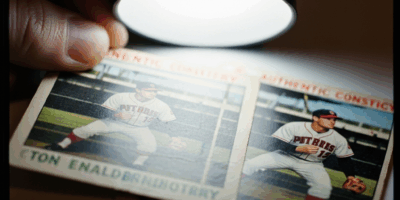
A good light source might be the best option, as football card evaluation requires seeing surface wear that’s invisible under overhead lighting. That is because scratches and print artifacts only show up when light hits the card at an oblique angle — hold it flat and you’ll miss half the flaws that a grader will catch immediately.
Here’s what to check, in order:
- Corners — The first thing PSA checks and the most common grade-killer. Sharp corner tips under a loupe are a genuinely good sign. Fuzzing, fraying, or even slight rounding costs you at minimum one grade point.
- Centering — Measure the borders. Left-right and top-bottom. A card that looks centered to the eye often measures 65/35 or worse, which kills a PSA 9 immediately. Buy a centering tool or learn to eyeball it accurately.
- Surface — Hold the card under direct light at a low angle and rotate it slowly. Scratches, print artifacts, and fingerprint oils all appear this way. They don’t appear under overhead room lighting.
- Back — Flip it. Check for staining, ink bleeding, paper loss, and writing. Pencil marks on the back — usually old price notations — can drop a grade. So can rubber band marks, which show up as faint indentations across older cards.
Where to Buy and Sell Valuable Football Cards
Football card sales have gotten complicated with all the platforms competing for the same inventory. Here’s where the actual market lives right now:
Auction Houses
Heritage Auctions and PWCC are the two dominant players for high-value graded cards. Heritage runs regular sports card auctions with serious buyer pools and transparent price records. PWCC operates a weekly auction model with strong volume at the mid-to-high tier. Both charge buyer’s premiums — typically 20–25% on top of the hammer price — which matters significantly when you’re calculating true cost on a $50,000 card.
Goldin Auctions is the third major house, with a reputation for record-setting sales and a collector base that leans toward high-profile modern cards. The Brady $3.1 million sale ran through Goldin.
eBay
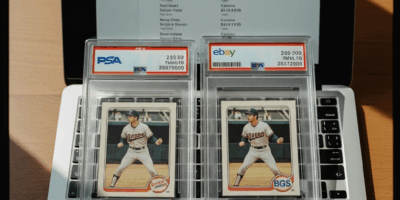
Still the largest marketplace for football cards by raw transaction volume. The sold listings function is invaluable for price research — filter by “Sold Items” and you have a real-time price history for almost any card in the hobby. Raw cards sell well here. Graded cards sell well here. The risk is authentication on raw vintage purchases from unknown sellers, which is why buying graded through eBay is considerably safer than buying raw.
Card Shows
The National Sports Collectors Convention runs annually and draws the largest concentration of serious inventory in the hobby. Regional shows happen in most major cities. Card shows are where raw deals still occasionally happen — a dealer who bought a collection and hasn’t fully researched every card sometimes prices things below market. That’s rarer than it used to be, but it still happens. I found a raw 1957 Topps Unitas at a show in Cleveland priced at $180 that graded PSA 6 — not a home run, but a solid return.
Online Platforms — COMC and Whatnot
Check Out My Cards (COMC) functions as a consignment platform where collectors can buy and sell without direct negotiation. Prices are fixed, inventory is deep, and the search function makes it genuinely useful for building sets or tracking specific cards. Whatnot is a live auction streaming platform where sellers run real-time card breaks and auctions — it’s chaotic and entertaining, and prices occasionally run below market when viewer engagement is low.
Grading Services — PSA, BGS, and SGC
Three grading services dominate the football card market. Each has a different reputation, different grading standards, and different market acceptance.
PSA (Professional Sports Authenticator)
PSA is the most recognized name in card grading — full stop. A PSA grade carries the most liquidity in the resale market, meaning PSA-graded cards sell faster and often at higher prices than equivalent cards graded by competitors. Their registry system lets collectors build and compare graded sets publicly, which drives competitive collecting at the high end. Submission turnaround currently runs weeks to months depending on the service tier chosen. Prices range from $25 for the economy tier to $10,000+ for the premium same-day walkthrough service at major shows.
BGS (Beckett Grading Services)
BGS might be the best option for modern cards, as the football card market increasingly requires subgrade transparency. That is because BGS grades four components separately — centering, corners, edges, and surface — and prints all four subgrades on the label. A BGS 9.5 with a 10 autograph subgrade on a Brady Championship Ticket is meaningfully more valuable than a BGS 9.5 without that subgrade breakdown. For modern autos and patch autos, BGS labeling carries real informational value that PSA doesn’t replicate.
SGC (Sportscard Guaranty)
SGC has built a strong reputation specifically in the vintage card market. Their black label holders are visually distinctive, and their grading standards for pre-war and early postwar cards are respected among serious vintage collectors. SGC graded cards don’t carry the same resale liquidity as PSA in most cases, but the gap has narrowed significantly over the past five years. For vintage collectors who care about accuracy over brand recognition, SGC is a legitimate option.
Building a Football Card Collection That Holds Value
As someone who made almost every mistake possible in this hobby over fifteen years, I learned everything there is to know about what separates collections that appreciate from collections that stagnate. The answer isn’t complicated. It’s just discipline.
Buy the Best Grade You Can Afford
The single most consistent piece of advice from long-term collectors is to buy the best grade you can afford rather than owning more cards at lower grades. A PSA 8 Jim Brown rookie is worth more than ten PSA 5 Jim Brown rookies combined — and it’s easier to sell, easier to store, and more satisfying to own. Grade compression at the high end of the scale is real and consistent across almost every key card in the hobby.
Focus on Key Cards, Not Full Sets
Full set collecting was the dominant strategy through the 1980s and early 1990s. The market has shifted. Today, the value concentrates in key rookies, key autographs, and low-numbered parallels. Completing a full 1957 Topps set is a legitimate collecting goal — but the Unitas and Starr rookies account for the vast majority of the set’s total value. Allocating budget toward those two cards and passing on the commons is the strategy most collectors use now.
Document Everything
Keep purchase receipts, auction records, and grading submission confirmations. Insurance coverage for high-value cards requires documentation of original purchase price. The IRS considers card sales taxable events when cards are sold at a profit — documentation of your cost basis matters when cards you bought for $500 sell for $5,000. This is genuinely unsexy advice, but it’s the kind of thing that matters when the collection is worth real money.
Storage Matters More Than Most Collectors Admit
Raw cards stored improperly deteriorate. Humidity damages cardboard. UV light fades color. Rubber bands leave marks. The standard recommendation for raw vintage cards is individual penny sleeves inside semi-rigid holders, stored in a climate-controlled environment away from direct light. For high-value raw cards, a small fireproof safe with silica gel packs controlling humidity is worth the investment. I learned this after a basement flood destroyed about $3,000 worth of raw vintage cards I’d been “temporarily” storing in a shoebox. Temporarily lasted four years.


Stay in the loop
Get the latest collector sports world updates delivered to your inbox.