
Why Turnaround Time Actually Matters for Sellers
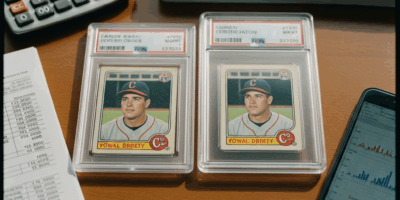
Beckett vs PSA grading turnaround times has gotten complicated with all the conflicting advice flying around. And honestly, I wish I’d done more homework before shipping eleven cards off in January — only to watch a rookie’s hot streak peak in February while my submissions collected dust in a queue somewhere in California. That was an expensive lesson. The card I was counting on — a 2023 Jasson Dominguez prospect card I pulled from a $25 blaster box — dropped roughly 40 percent from its peak value by the time it came back. PSA 9. Mint condition. Completely dead in the water by that point.
Here’s what nobody says plainly enough: every card sitting at a grading company is frozen capital. You can’t list it. Can’t sell it. Can’t pivot when the market shifts underneath you. For collectors building a display case, that’s fine — irrelevant, even. But for anyone flipping cards to generate actual income, turnaround time is the entire financial equation. Not the grade. Not the label color. Not the pop report. The clock.
Rookie cards are brutally time-sensitive. A player’s first full season, a playoff run, one breakout game — these windows close fast. A card worth $180 in October can be worth $60 by December with zero change in condition or scarcity. Sending it out for grading is a bet that it lands back in your hands before the window shuts. So let’s look at what the timelines actually look like — not what the websites advertise, but what collectors are reporting.
PSA Service Tiers and How Long They Actually Take
PSA runs several service levels right now, and the gap between advertised and real-world turnaround gets pretty wide once you drop below the $100 tier.
- Economy — $25 per card: Advertised at 100 business days. Real-world reports pulled from the PSA subreddit and collector forums throughout 2024 put the actual range somewhere between 90 and 160 days. That upper end isn’t some rare outlier, either.
- Value — $50 per card: Advertised at 45 business days. Most collectors land somewhere between 45 and 75 days in practice. More consistent than Economy, but still slippery enough to cause problems if you’re working against a deadline.
- Regular — $100 per card: Advertised at 20 business days. Real-world results tend to fall between 20 and 35 days. This is where PSA starts behaving like a service you can actually plan around.
- Super Express — $250 per card: Advertised at 5 business days. Generally holds. Most collectors report delivery within 5 to 10 business days — the first tier where PSA feels genuinely reliable.
- Walk-Through — $600+ per card: Same-day or next-day, on-site. Used almost exclusively for high-value vintage pieces or auction-deadline submissions.
PSA had catastrophic backlogs in 2021 and 2022 — sometimes stretching past a full year at Economy — when the hobby exploded during the pandemic. Those delays have largely cleared. But the infrastructure strain left habits behind. PSA still batches submissions and processes in waves, which creates variance even when volume is manageable. The submission tracker is actually worth checking now, which genuinely wasn’t the case two years ago.
Beckett Service Tiers and Real Wait Times
Beckett’s pricing structure runs roughly parallel to PSA’s — but with some real differences in how consistently they hit their windows.
- Economy — $22 per card: Advertised at 65 business days. Real-world range lands between 65 and 110 days. Slightly cheaper than PSA’s Economy tier, and the advertised estimate is more honest, but that ceiling is still high enough to hurt a time-sensitive flip.
- Standard — $35 per card: Advertised at 30 business days. Collectors generally report 30 to 50 days. Beckett is noticeably more consistent here than PSA’s comparable Value tier — same neighborhood, tighter spread.
- Express — $125 per card: Advertised at 10 business days. Real-world results come back at 10 to 18 days with reasonable reliability. This is one spot where Beckett outperforms PSA on both speed and price simultaneously.
- Premier — $300 per card: Advertised at 5 business days. Generally holds. Reserved for higher-value submissions where predictability matters most.
One thing worth factoring in: Beckett grades with sub-grades — centering, corners, edges, surface — which adds a small layer of processing complexity per card. Whether that meaningfully delays batches is genuinely debated. But anecdotally, Beckett’s mid-tier timelines feel tighter and more predictable than PSA’s equivalent price points. Probably should have opened with this section, honestly, because that consistency gap is what actually drives the decision for sellers working against a calendar.
Which Service Is Faster at Each Budget Level
Budget Sender — Under $30 per card
Winner: Beckett. At $22 versus PSA’s $25 Economy tier, Beckett comes in cheaper and delivers a more accurate estimate up front. PSA’s Economy ceiling of 160 days is a real risk — not a theoretical one. If budget is your hard constraint and you can tolerate the wait, Beckett Economy is the better bet.
Mid-Tier Flipper — $35 to $125 per card
Winner: Beckett. This is the bracket that matters most for active sellers. Beckett’s Standard tier at $35 runs faster and more predictably than PSA’s $50 Value tier. Step up to Express level and Beckett at $125 for 10 to 18 days beats PSA’s Regular tier at $100 for 20 to 35 days — you pay $25 more for meaningfully faster, tighter service. For cards sitting in the $150 to $600 value range, that speed difference more than earns its cost.
Premium Card Investor — $250 and up per card
Draw, with PSA slightly preferred. At this spend level, both services are fast and reliable enough to trust. PSA’s Super Express at $250 matches Beckett’s Premier at $300 in speed — so PSA wins on cost alone. For high-value cards where PSA population reports directly shape resale value, PSA also carries the market depth advantage. On eBay, a PSA 10 on a premium card typically commands more than a BGS 9.5 Pristine. That affects your net even when grading costs run higher.
When to Choose PSA and When to Go With Beckett
Burned by a slow turnaround, I now run a simple decision before any submission. Here’s the practical version — the one I actually use.
Choose Beckett if you’re submitting mid-tier cards in the $50 to $300 value range, you care about timeline reliability over label prestige, or you’re grading modern cards where sub-grades add resale context on platforms like COMC or Beckett Marketplace. Beckett is also the smarter call if you’re a volume flipper moving five to fifteen cards at a time. The Standard tier’s consistency means you can actually plan your inventory cycles instead of just hoping.
Choose PSA if the card’s value is partly driven by pop report positioning, you’re selling to buyers who specifically ask for PSA slabs, or your submission qualifies for Super Express and speed is the only variable that matters. PSA’s brand recognition on eBay still pulls more buyer interest at higher price points — that’s just the reality of the secondary market right now.
As of early 2025, PSA submission volume appears to be running at a manageable level and their tracker is functional enough to actually rely on. Beckett hasn’t reported unusual delays either. Both services are operating closer to their advertised windows than at any point since 2020 — which is worth something after the chaos of the previous few years.
For the most common use case — one to five mid-value modern cards, graded with intent to sell within a quarter — Beckett is the better choice. The Standard and Express tiers deliver faster, tighter turnarounds in this price range. And for a seller working against a real deadline, predictability is worth more than the PSA label bump. Don’t make my mistake.



Stay in the loop
Get the latest collector sports world updates delivered to your inbox.