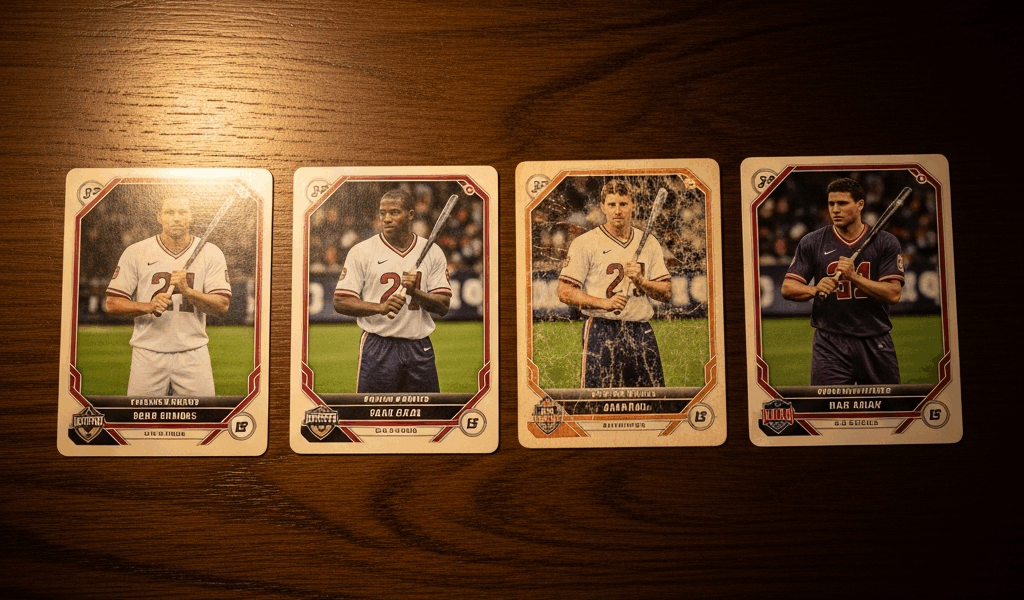
Why the 1 to 10 Scale Matters More Than You Think
Sports card grading has gotten complicated with all the misinformation flying around. So let me cut straight to what changed my entire approach: I sold a 1986 Topps Jose Canseco rookie card last year for $1,200. Same card, graded one point lower by the same company six months earlier, moved for $720. One grade point. Forty percent — gone.
As someone who’s mailed off hundreds of cards to PSA and Beckett over the years, I learned everything there is to know about where a card actually sits on that scale before it ever leaves my hands. Today, I will share it all with you.
But what is the grading scale, exactly? In essence, it’s a 1-to-10 numbering system where 10 is theoretical perfection and 1 is barely-still-cardboard. But it’s much more than that. Each number represents a price bracket. Each bracket has a floor. On high-demand rookies, vintage Hall of Famers, and modern chase cards, the spread between a PSA 7 and PSA 8 can swing $300 to $600 depending on player and year. Between an 8 and a 9 — often double or triple the price. Most collectors don’t know this going in. They submit hoping for an 8, receive a 6, and suddenly their $150 card is worth $85 raw.
You don’t need a professional grader’s eye to self-assess within one grade. An honest light source, a loupe or phone camera, and real knowledge of what to look for — that’s the kit. This article gives you that. Real-world descriptions. Not the vague language grading companies bury on their websites. So, without further ado, let’s dive in.
Grades 1 Through 4 — Cards That Have Seen Hard Life
Let me be direct. A PSA 1, 2, 3, or 4 has damage. Visible, unmissable damage. Heavy creases. Corners rounded so soft you can barely feel an edge. Staining. Writing on the front or back. Tape marks. Water damage. These cards have genuinely lived.
A PSA 1 looks like it spent thirty years in a shoebox under a bed and then got found by a dog. Creases run across the face. The image is barely recognizable without squinting. Corners aren’t worn — they’re gone. Color is faded or discolored entirely. This card was played with, lived in a pocket, or stored somewhere that would make a conservationist weep.
PSA 2 and 3 are rough, but you can still read the card. Creases remain, though structural integrity improves slightly as you move up. Corners are rounded down to almost nothing — you can still identify edges, barely. Stains or marks are visible, but the card still reads as the player and year it claims to be.
PSA 4 is where cards start approaching what collectors call “playable condition.” Creases exist but don’t dominate the image anymore. Corners show heavy wear and still retain some definition — hold the card up and you can see all four corners, even if they’re soft. Surface may carry light stains or foxing, those brown age spots that show up constantly on vintage stock.
Here’s the honest truth about submitting in this range: most collectors shouldn’t bother — at least if the card doesn’t have serious raw value on its own. A 1952 Mickey Mantle in PSA 3? Grade it. The raw value is enormous enough that even a damaged copy fetches real money. A 1990 Leaf Frank Thomas in PSA 2? Don’t make my mistake. You’re paying $15 to $30 in grading fees to certify a card worth maybe $40 unslabbed.
The exception is vintage cards, genuinely scarce issues, or anything you want authenticated and slabbed for display regardless of value. Outside of that — binder or storage box, raw.
Grades 5 Through 7 — The Misunderstood Middle
Probably should have opened with this section, honestly. This is where most collectors lose money before they even drop their submission in the mail.
A PSA 5 shows obvious wear — no major damage, but nothing subtle either. Corners are noticeably rounded. Under a loupe with good angled light, all four corners look soft, worn, but present. Edges show discoloration or scuffing along the white border. Surface carries visible wear marks. Light creases may appear, though nothing like the heavy creasing on lower grades. Centering is often slightly off, meaning borders around the image don’t sit evenly on all sides.
A PSA 6 looks better. Noticeably better. Corners have more definition — you can see the corner point in profile, not completely rounded away. Edges show wear, less dramatically than a 5. Surface wear is visible but light. No creases. Centering may still run noticeably off on one or two sides, but color is good. The card looks like it was handled regularly and cared for reasonably well.
A PSA 7 — and this part matters — looks genuinely nice in hand. Corners show only light wear. Examined with a loupe at an angle, the corner points are visible and defined. Edges are clean. Surface is clean to the naked eye. Under direct magnification you might catch a light mark or two, but nothing jumps out. Centering is good. Maybe slightly off on one border, but nothing dramatic. A PSA 7 is a card you’d happily display in a case.
Here’s where collectors consistently misgrade themselves. They look at a card casually and think “this looks nice, I’ll submit for an 8.” Card comes back a 7 or 6, and they’re genuinely shocked. The issue is never the card — it’s that they weren’t looking hard enough. No loupe. No angled light. No systematic centering check.
Corner wear is the most common grade-killer in this range. Corners are graded harshly because they’re the first thing to go when a card is shuffled, stacked, or stored loosely. A card looking solid to the naked eye often carries subtle corner wear that pulls it from an 8 to a 7. Centering is second. Image sitting noticeably off to one side or toward the top — that’s a grade-killer too. I’m apparently more sensitive to off-center cards than most collectors, and checking centering first works for me while eyeballing corners second never works the same way.
A PSA 7 on the right card is absolutely worth submitting. Grading fees run $10 to $25 depending on declared value, and the price jump from raw to slabbed PSA 7 on a popular rookie or key vintage issue often lands between $100 and $400. Do the math. Submit it.
Grades 8 Through 10 — Where the Real Value Lives
A PSA 8 is a beautiful card. Corners carry only the slightest wear — you need a loupe and angled light to find it. To the naked eye, corners look sharp. Edges are clean and crisp. Surface shows nothing without magnification. Centering is very good, minimal off-center on any border. Color is vibrant. It looks like someone opened the pack, glanced at the card, and immediately sleeved it.
The gap between an 8 and a 9 is where pricing gets aggressive. A PSA 9 requires near-flawless corners — under a loupe they should look nearly pristine. Edges crisp with zero visible wear. Surface spotless to the naked eye. Centering excellent on all four borders, nearly perfect distribution. A PSA 9 is a card that spent its entire existence in a sleeve inside a box.
A PSA 10 is theoretical perfection. That was 1996 thinking — now it actually exists in meaningful quantities, but it’s still rare. Corners must be absolutely sharp with zero visible wear under magnification. Edges flawless. Surface pristine — no scratches, no print lines, no marks under strong light. Centering perfect or near-perfect on all four sides. Print quality excellent with no factory defects visible. A PSA 10 was packed, never opened, stored in climate-controlled conditions, and graded exactly once.
Between a 9 and 10, price jumps run 300 to 500 percent on desirable cards. A $2,000 PSA 9 rookie might be a $6,000 to $10,000 PSA 10. The difference in hand? Imperceptible to most people. But to collectors and investors, it’s the line between a played card and a pristine one. That’s what makes the PSA 10 endearing to us collectors — it represents something almost unreachable.
While you won’t need a professional grading setup, you will need a handful of tools to assess 8-through-10 territory accurately. Surface scratches under light, factory print lines that mimic surface damage, centering tolerances measured in millimeters, microscopic edge nicks — these are the things that trip up self-graders at the top of the scale. A single light scratch visible only under a bright loupe can drop a 9 to an 8. A print line that looks like wear can do the same.
BGS — now Beckett Grading Services — grades on a 1-to-10 scale with half-point increments, so a BGS 9.5 is often compared to a PSA 10 in resale value, though the two companies grade with slightly different strictness standards. That comparison deserves its own deep-dive and is covered elsewhere in depth.
How to Grade Your Own Cards Before You Submit
First, you should gather your tools — at least if you want an honest assessment. An LED desk lamp or direct sunlight works as your light source. A loupe, or your phone camera’s maximum zoom. Clean surface. Here’s the exact order of operations.
Step One — Corners
Look at all four corners under angled light with magnification. Sharp and defined, or soft and rounded? Can you see the actual point of the corner, or has it worn away entirely? This is the single biggest grade factor in existence. Spend two full minutes on corners alone — at minimum.
Step Two — Edges
Run your eye along all four edges. White border crisp, or discolored and scuffed? Any nicks or soft spots along the edge line? Edges age visibly, especially on cards printed before 1985.
Step Three — Surface
Examine the image itself under bright direct light. Scratches? Print lines? Creases? Stains? Check both sides. Flip the card and give the back the same attention as the front. Surface damage is easy to spot once you’re actively hunting for it.
Step Four — Centering
Hold the card at arm’s length and look at the borders. Image centered evenly, or sitting too far left, right, or toward the top? Bad centering doesn’t hide. It jumps out immediately once you’re looking for it.
Step Five — Overall Assessment
Corners sharp, edges clean, surface spotless, centering good — you’re likely looking at a 7 or 8. Any of those fail, especially corners, and you’re probably at a 6 or below.
Submit when the card grades 7 or higher on your own honest assessment, the player is desirable or the card is vintage, and the likely grade-bump in value clears your submission cost by at least $50. Otherwise, keep the card raw. That’s the whole system. Simple, but most collectors never use it.

Stay in the loop
Get the latest collector sports world updates delivered to your inbox.