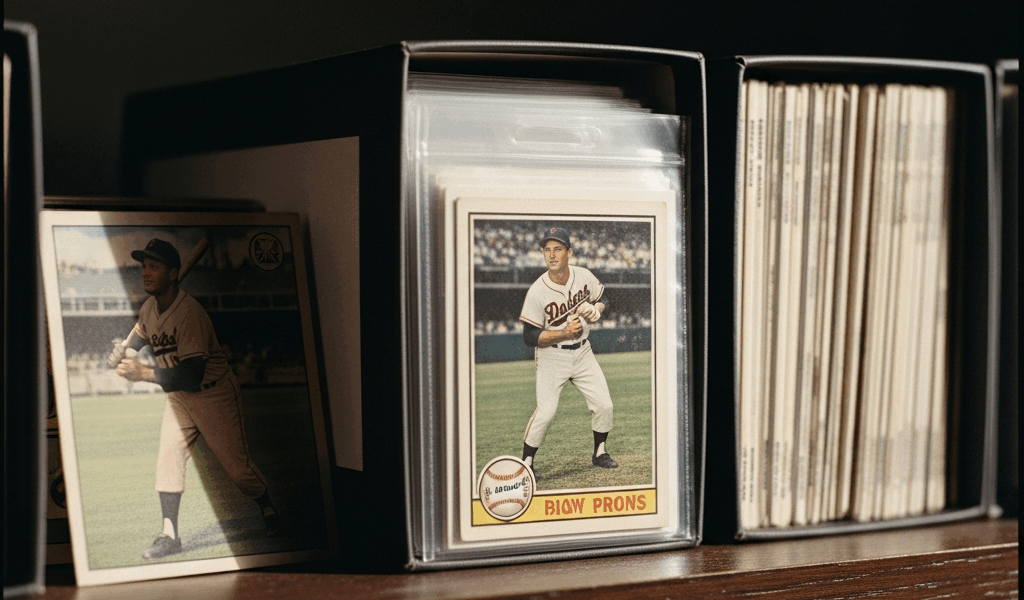
Why Bad Storage Kills Card Value Fast
Sports card storage has gotten complicated with all the conflicting advice flying around. And honestly, most of it misses the part that actually matters — the silent damage you never see coming.
I bought a 1990 Frank Thomas rookie card in mint condition for $800 back in 2019. Stored it loosely in a desk drawer near a window for one summer while I was between apartments. Nothing dramatic. No floods, no fires. Just a drawer. When I finally got it graded six months later, it came back PSA 7 instead of the PSA 9 I expected. That card lost $400 in value from humidity warping and UV fading I never once noticed happening. Don’t make my mistake.
So what actually destroys cards? In essence, it’s three forces working silently against your collection. But it’s much more than just “keep them somewhere dry.” Humidity warps cardboard and cracks gloss. Sunlight fades ink and kills color saturation. Loose storage creates micro-bends at the edges — the kind graders catch immediately under magnification.
A card stored wrong for a single season can drop two to three full PSA grades. That’s not hyperbole. That’s the difference between a card worth $500 and one worth $200. Today, I’ll share everything I know about stopping that from happening.
The Right Sleeves and Top Loaders to Use
Probably should have opened with this section, honestly — sleeve choice determines everything that comes after it.
Most people start with penny sleeves. They’re cheap, they exist everywhere, and they feel protective. Then reality sets in.
- Penny sleeves — Use these only for bulk storage or cards under $5. PVC or polypropylene construction, almost zero rigidity, and the card slides around inside creating friction wear on corners. They do absolutely nothing to stop a bend.
- Semi-rigid holders — These are the forgotten middle ground. BCW semi-rigid sleeves run about $0.15 each and hold the card flat with actual structural protection — no overkill, no bulk. Good for cards worth $20–100. The card doesn’t move. Corners stay safe.
- Hard top loaders — Non-negotiable for anything over $100 or anything headed to a grading company. Ultra Pro and BCW top loaders run $0.25–0.40 each. Rigid enough that bending simply isn’t possible. But here’s where it gets complicated.
This last point catches everyone off guard. Modern Prizm, Select, and Optic cards print thicker than vintage stock. A standard top loader sized for 1990s cardboard will sit loose around a 2020 Panini card — and that looseness means movement, which means corner wear. Ultra Pro makes their Premium Thick Loader at $0.50 each specifically for modern cards. Use it.
Always double-sleeve. Card goes into a thin soft sleeve first — Beckett Perfect Fit sleeves run about $0.05 each — then that goes into the semi-rigid or top loader. That air gap stops the card from touching hard plastic directly. It matters more than people think over long storage periods.
How Humidity and Heat Damage Cards Over Time
Humidity is the silent killer. Nobody notices it until grading day.
But what is the ideal storage environment? In essence, it’s 35–50% relative humidity held at 65–70°F. But it’s much more than just hitting those numbers once — stability is what actually protects cards. Outside that window, cardboard absorbs and releases moisture continuously, warping the card and separating the gloss layer from the stock underneath. You’ll see it as rainbow-colored surface cracking or a visible wave pattern across the card face.
Most people store cards in garages, basements, or attics. All three are mistakes. A garage swings 30 degrees between seasons. Basements hold moisture year-round — especially in humid climates. Attics hit 120°F in summer and freeze in winter. I’ve personally seen cards stored in an uninsulated garage shed for two years come back with edge damage across all four corners from cardboard repeatedly shrinking and expanding. That’s what temperature instability actually looks like.
Keep cards inside your main living space — a bedroom closet, an interior cabinet, or a desk drawer away from windows. Temperature stability matters more than perfect temperature.
If a basement or garage is unavoidable, silica gel packets are cheap insurance. I’m apparently someone who obsesses over this, and the Blue Silica Gel rechargeable packets from Amazon work for me while the cheap drugstore versions never actually hold up. Around $8 for a bulk pack. Place 2–3 packets inside your sealed storage box and check them monthly — they turn pink when saturated. Recharge them by baking at 300°F for an hour. Simple system, genuinely effective.
Never store cards near windows, lamps, or bright fluorescent lights. UV exposure doesn’t fade cards overnight — it happens across months, creating color shifts that graders mark immediately. A PSA 9 card with heavy red coloring can shift to an orange tint within a year of window storage. Slow, invisible, permanent.
Binders vs. Boxes — Which Is Better for Your Collection
The binder question splits collectors right down the middle. That’s what makes it endearing to us collectors — everyone has strong opinions and personal systems they swear by. So, without further ado, let’s dive in.
For cards under $20, binders are acceptable — at least if you use acid-free, PVC-free pages. Most standard binder pages contain PVC as a plasticizer, and over months it migrates directly into card stock, creating sticky residue and permanent staining. Ultra Pro Premium pages run $0.50 each and are clearly marked PVC-free. Use those or don’t use binders at all.
But even PVC-free pages carry real risk. Rings put pressure on card edges. Cards rub against each other. The binding mechanism creates stress points that accumulate over time. For anything over $100, this is unacceptable.
Boxes are the answer for valuable cards. Standard white cardboard storage boxes run $2–4 each and hold 2,000+ cards safely when combined with proper spacing dividers. Acid-free boxes only — never the cheap brown corrugated kind from hardware stores. Cards go into semi-rigid holders or top loaders, then stand vertically in rows with plastic dividers between sections. Nothing bends. Nothing presses.
Here’s the clearest breakdown I can give you: under $20 per card, use a PVC-free binder if accessibility matters to you. Over $100 per card, use acid-free storage boxes with proper holders, full stop. The $50–100 range is judgment call territory. Planning to sell within two years? Use boxes. Building a display collection you won’t touch often? A binder is probably fine.
Long-Term Storage Mistakes That Cost Collectors Money
Five errors quietly destroy collections over time:
- Rubber bands around stacks — Creates permanent crease marks on top and bottom cards. Edge damage shows up immediately to graders. Never use them.
- Stacking cards without protection between layers — Weight accumulates fast. The bottom card of a 50-card unprotected stack will show visible corner wear. Use dividers or individual holders, always.
- Storing near windows, lamps, or heat sources — Direct sunlight and heat accelerate warping and fading across 6–12 months. You won’t see the gradual damage until grading day arrives.
- Using standard PVC binder pages on valuable cards — Chemical staining is permanent and regularly drops grades by 2–3 points. Graders see it immediately under magnification. That was probably a $300 lesson for someone you know.
- Skipping graded slabs on high-value raw cards — Raw cards you plan to hold long-term should be graded first if value clears $300. PSA and BGS slabs are engineered for decades of preservation. The grading fee runs $20–100 depending on service tier — cheap insurance against future deterioration.
Storage isn’t exciting. It doesn’t get you new cards or make the hobby feel alive the way ripping packs does. But it’s the difference between a collection that holds value for a decade and one that slowly dies in a drawer. Start with proper sleeves, control humidity, block sunlight, use appropriate boxes, and get high-value cards graded before long-term storage. That’s how you protect what you actually own.

Stay in the loop
Get the latest collector sports world updates delivered to your inbox.