Why Rookie Card Fakes Are Getting Harder to Catch
Spotting fake rookie cards has gotten complicated with all the sophisticated counterfeiting noise flying around these days. As someone who has spent fifteen years digging through card shows, eBay listings, and dusty dealer boxes, I learned everything there is to know about how fakes have quietly gotten terrifying. Today, I will share it all with you.
We’re not talking about cheap overseas reprints anymore. The modern counterfeit operation uses high-resolution inkjet printing, chemical washes to fake cardstock aging, and trimming techniques so clean they fool buyers in seconds flat. The 1952 Topps Mickey Mantle, the 1909-11 T206 Honus Wagner, and the 1986 Fleer Michael Jordan rookie sit at the top of the most-faked list. All three flood eBay and Facebook Marketplace constantly — the profit margin is just insane. A convincing fake moves for $500 to $2,000. Manufacturing costs? Under fifty bucks.
But what makes modern fakes genuinely difficult to catch? In essence, counterfeiters now study the originals. But it’s much more than that. They source paper that mimics aged cardstock. They know Topps changed printing methods in 1973, shifted gloss levels around 1980, and adjusted color separations across factory runs. This is calculated. Deliberate. Methodical. That’s what makes this era of counterfeiting so dangerous to collectors like us.
So, without further ado, let’s dive in.
Check the Edges and Corners First
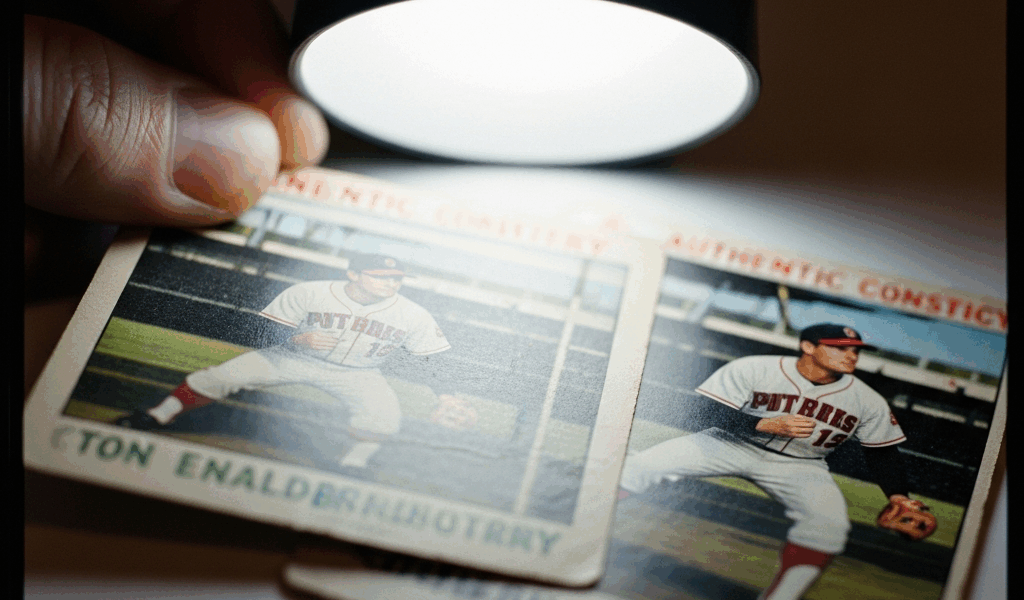
Start here. Every single time. Forget the image, the centering, the player’s face — go straight to the edges and corners. Trimmed cards are the most common counterfeit cheat because they’re fast to execute and nearly invisible in photos.
A real factory edge has a soft, slightly frayed look — paper fibers naturally separate during the cutting process. On vintage cards from the 1950s and 1960s, you’ll notice what I call “fiber fuzz.” The corners are rounded but not perfectly uniform. Organic inconsistency is the whole point. A sharp, clean, razor-blade edge with pristine 90-degree corners? Walk away immediately. That card has been trimmed.
Frustrated by a nagging suspicion about a listing, I nearly handed over $1,800 for a 1968 Nolan Ryan rookie from a seller in Pennsylvania. The scan looked immaculate — beautiful centering, clean surface. I asked for close-ups of all four corners before committing. The right edge looked wrong. Too sharp. Too consistent. I asked the seller directly whether it had ever been trimmed. Radio silence. Then he dropped the price to $900. That was my confirmation.
Compare border width on all four sides. Authentic cards show relatively even borders, though small variance from factory printing is totally normal. Trimmed cards go asymmetrical — the trimmer never starts from the same reference point twice. Top border at 3 millimeters and bottom at 2 millimeters? Something is wrong. Don’t talk yourself out of that instinct.
While you won’t need a professional authentication lab, you will need a handful of basic tools. A magnifying loupe runs $8 to $15 on Amazon — I use a 10x Carson model I grabbed for $11. If you’re working from seller photos, the magnifier app on your iPhone or Android gets you to 200% zoom easily. The edges will tell you everything in about thirty seconds.
What the Print and Color Should Actually Look Like
Authentic offset-printed cards — which covers nearly everything pre-1990 and most modern releases — have a specific visual signature under magnification. You’re looking for a rosette pattern. Cyan, magenta, yellow, and black inks layered in precise angles, creating tiny organized dots that almost resemble a fingerprint under a loupe. That’s the real thing.
Inkjet fakes don’t have rosettes. Instead you get solid blobs of color sitting on top of the cardstock rather than pressed into it. Under magnification, the edges of colored areas look fuzzy or pixelated — not clean and geometric. Probably should have opened with the magnifier thing, honestly. It solves about 70% of the problem right there. The remaining 30% requires knowing what you’re actually looking for once you’re zoomed in.
Color saturation matters enormously. A 1975 card has a slightly matte finish with colors that sit rich but not glossy. A 1986 card shows brighter saturation with a semi-gloss coating. A modern reprint made using current CMYK separations looks too vivid, too clean, too new — even after chemical aging. The eras have fingerprints, and fakers can’t fully erase them.
I’m apparently terrible at catching yellow tones, and that gap in my eye cost me $600 once. I bought what I thought was a 1971 Willie Mays — the yellow on the Giants uniform practically glowed off the card. Authentic 1971 Topps cards have a muted, warm color palette. Dull gloss, not reflective. I returned it within a week. The seller didn’t push back at all, which told me everything. Don’t make my mistake. Study the color profiles of the specific year you’re chasing before you open your wallet.
Surface texture is your last tactile check. Run your fingernail gently across the front. Vintage cards have a subtle grit from the cardstock itself. Reprints feel smoother — sometimes slightly waxy from the glossy coating. You can’t do this from photos, which is exactly why in-person inspection or a trusted seller relationship matters so much.
Red Flags in Seller Photos and Listings
Before you even consider opening your wallet, look at how the card is being presented.
- Blurry or low-resolution photos. A seller hiding surface details is hiding something. Demand clear, well-lit images of front and back — taken straight on, not at flattering angles that obscure edge condition.
- Card back not shown. Dealbreaker. Full stop. The back reveals printing era, cardstock weight, and whether the card has been cleaned or reprinted. No back photo means no purchase.
- Weight and thickness not mentioned. Real cards have specific gravity. A 1986 Fleer Jordan rookie weighs approximately 1.8 grams and measures around 2.5mm thick. A seller who can’t provide those specs either doesn’t know their inventory — or they do know, and they’d rather you didn’t ask.
- Price suspiciously below PSA comp values. If PSA pop report shows the last three sales of a PSA 8 at $3,500 and someone is offering theirs at $1,200, ask why. Sometimes there’s a real explanation. Sometimes you’re looking at a counterfeit. Push until you know which.
- No return policy or a suspiciously tight return window. Legitimate dealers offer 30-day returns with authentication guarantees. Scammers offer three days — or nothing at all.
Ask the seller directly: “Has this card ever been cleaned, trimmed, or restored in any way?” Their answer — or non-answer — matters more than they realize. Ask about provenance. Ask whether it’s been graded before and why it isn’t graded now. Hesitation is a signal. Silence is a louder one.
When to Walk Away vs. When to Get It Graded
Here’s the decision tree — at least if you want to protect yourself consistently.
Multiple red flags stacking up? Blurry photos, missing back, sharp edges, oversaturated colors, price that seems too good to be true — walk away. Don’t negotiate. Don’t send a follow-up email. The market is deep enough that legitimate examples exist. Find them instead.
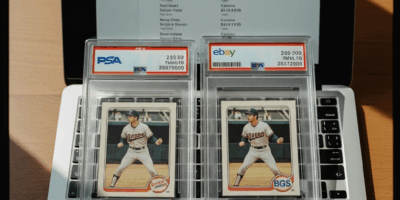
One uncertain flag? Maybe the photo lighting makes the color look slightly off, or the seller just forgot to photograph the back. That’s where grading earns its fee. PSA and Beckett see thousands of cards monthly. They know era-specific variations that most collectors will never study deeply enough to catch independently.
The value threshold drives the math. A $40 raw card doesn’t justify a $25 grading fee — that’s obvious. But a card worth $150 or more? A $25 to $50 grading fee is just insurance, and graded cards sell faster and at higher prices anyway. The fee often pays for itself before you even factor in fraud protection.
My rule: if I’m uncomfortable with my own inspection and the raw value clears $100, I grade it. Period. First, you should establish that threshold for yourself — at least if you plan to buy regularly in the secondary market. The cost is negligible against what you’re protecting.
PSA might be the best option, as rookie card authentication requires consistency and deep institutional knowledge. That is because their population reports also give you real comp data that informs whether the asking price even makes sense before the card arrives in their hands.
Your eye — trained by these checks — is better than you think. Use your loupe, ask hard questions, compare those borders, examine the print pattern, and trust your gut when something feels wrong. Nobody cares more about authenticating your purchase than you do. That’s not a limitation. That’s actually your biggest advantage.

Stay in the loop
Get the latest collector sports world updates delivered to your inbox.