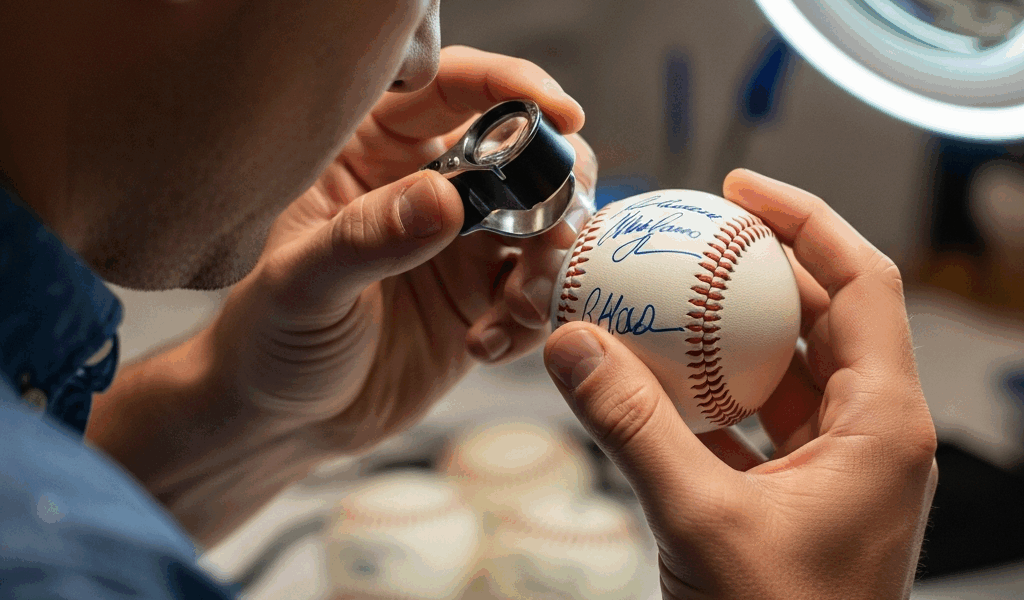
How to Tell if a Signed Baseball Is Real — Authentication Guide
Signed baseball authentication has gotten complicated with all the misinformation flying around — and honestly, the companies profiting from authentication services have zero incentive to actually teach you anything. As someone who’s been collecting autographed baseballs for over twenty years, I learned everything there is to know about separating real signatures from convincing fakes. It started with a Willie Mays single-signed OML ball I grabbed at a card show in Phoenix for $340 back in 2003 — genuine, as it turned out. Six months later I paid $275 for a “Ted Williams” that was absolutely not. That one stung. Don’t make my mistake.
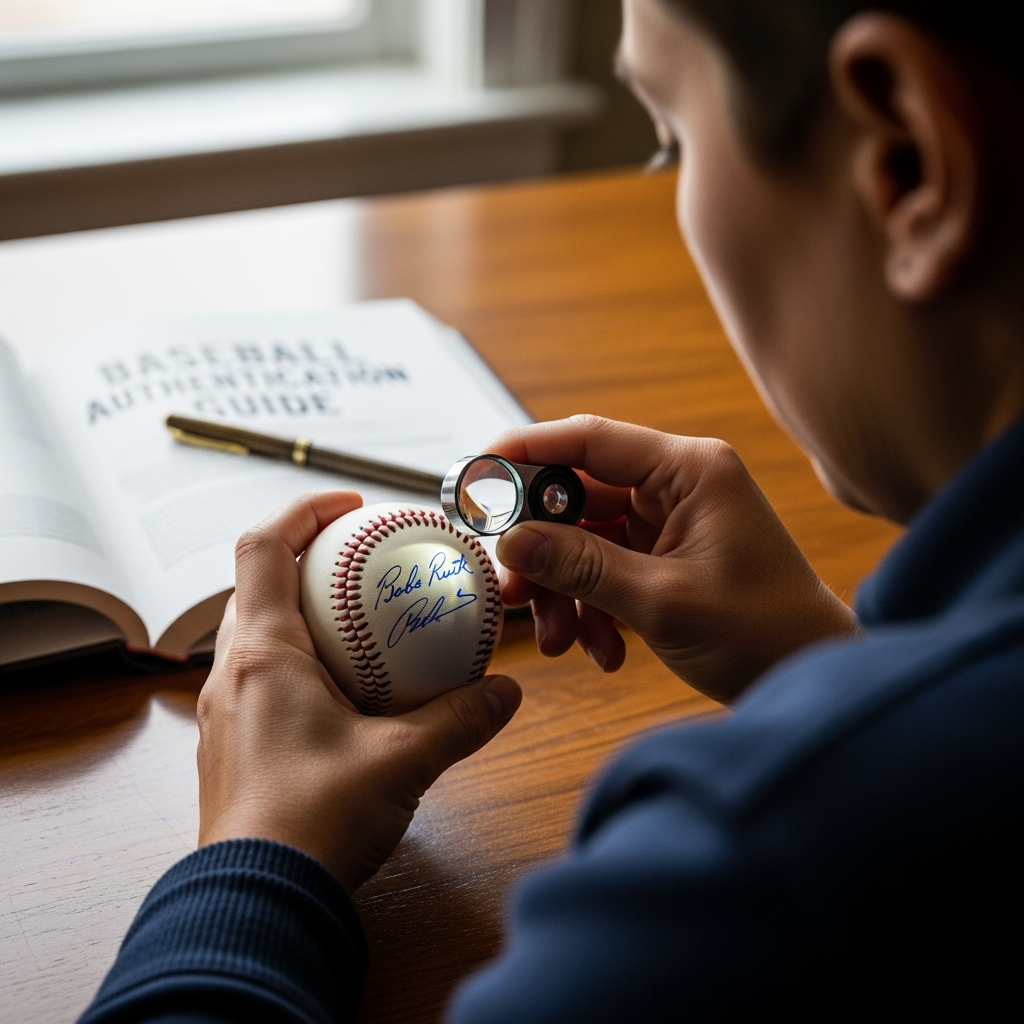
The Red Flags That Scream Fake
Fakes come in distinct flavors. Each leaves different evidence. Once you know the categories, spotting them gets fast — sometimes uncomfortably fast, especially when you’re at a show and the seller is watching you look.
The three types you’ll actually encounter are autopens, rubber stamps, and secretary-signed balls. All different problems. All fixable with the right knowledge.
Autopen Signatures
But what is an autopen? In essence, it’s a machine that grips a real pen and traces a pre-programmed signature path. But it’s much more than that — it’s the reason entire collections have been quietly worthless for decades. They’ve existed since the 1940s. JFK ran one for fan mail. Sports memorabilia circles got hit hard in the 1970s and 1980s.
The dead giveaway is mechanical consistency — inhuman consistency. Sign your name fifty times right now. No two will match exactly. Pressure shifts. Letter formation drifts. Ink flow changes depending on how long the pen sat uncapped.
An autopen signature doesn’t do any of that. Line width stays identical start to finish. Pen pressure never varies, which shows up under magnification as perfectly uniform ink density across every single stroke. Entry and exit points — where pen touches paper and lifts — are identical across every impression made with that program. If you’re looking at a player who received massive fan mail volume, Mickey Mantle in his later years being the obvious example, and twenty copies of his signature look exactly, precisely alike? Autopen. Full stop.
Get a 10x loupe — the Belomo 10x Triplet runs about $38 on Amazon and it’s what I’ve used for years. Examine stroke beginnings and endings. Autopen signatures often leave a tiny circular blob at entry and exit points where the mechanical arm briefly hesitates before lifting.
Rubber Stamp Signatures
Rubber stamps are actually easier to catch than autopens because the ink distribution is fundamentally wrong. A real pen deposits heavier ink at stroke starts and ends — where the hand slows down — and lighter ink through fast middle movements. A stamp deposits based purely on pressure and ink load. You’ll see either suspiciously even coverage across the whole signature, or a pattern where letter edges carry heavier ink while centers run slightly lighter.
Under magnification, stamped ink sits on top of the leather surface. A pen digs in — pushes cowhide fibers aside — and that interaction is visible and genuine. Stamps don’t create it. Also look for ink “squish,” that slight spread at letterform edges when a stamp contacts a surface. Real pen strokes don’t produce this. It’s subtle. It’s also unmistakable once you’ve seen it once.
Secretary-Signed Baseballs
Probably should have opened with this section, honestly. Secretary-signed material is what most collectors actually encounter — autopen gets more press, but secretaries did the real volume work, especially in pre-1980 material.
These are signatures applied by team employees, family members, personal assistants — anyone who learned to approximate a player’s signature well enough to handle fan mail. Real pens, which means no mechanical tells. What they lack is the unconscious signature DNA of the actual player.
Nobody signs their name the same way consciously as they do after ten thousand unconscious repetitions. A secretary copying a signature is always thinking about it. The result looks slightly labored — pen lifts in unusual spots, connections that look traced rather than flowing, an overall quality that’s easier to feel than to describe precisely. Compare against a known authentic example from the same era. Letter proportions relative to each other will be off. The baseline angle — every real signer has a habitual slant — will wander in ways the actual player’s never would.
What Real Signatures Look Like
Understanding fakes is only half the work. After that fake Williams ball, I spent three months at a major auction house examining authenticated pieces under magnification before they went to sale — pre-sale inspection access, which is something serious collectors don’t use nearly enough. Here’s what genuine autographs consistently show.
Pen Pressure Variation
Real signatures have rhythm. The signer’s hand accelerates through certain strokes, decelerates through others, and this shows up directly in line width. The Bic Cristal medium point — the most common signing pen from the 1960s through the 1990s, essentially the default — deposits heavier ink under slower strokes and lighter ink through fast ones. On a genuine signature, you see this as natural variation: thicker lines at name starts, thin whip strokes on loops, heavier deposits at natural pause points within the signature pattern.
Under the Belomo loupe, authentic ballpoint signatures show microscopic skip patterns — tiny gaps where the ball briefly lost contact with the surface during fast strokes. These are natural and nearly impossible to fake deliberately. They happen because the signer is moving faster than surface texture allows for perfect contact. A carefully forged signature, drawn slowly for accuracy, has continuous ink lines without skips. That continuity is actually the suspicious thing. Ironic, but there it is.
Natural Flow and Letter Formation
An authentic signature from a player who signed thousands of items evolves into something almost like personal shorthand. Letters get compressed, combined, dropped entirely. Derek Jeter’s mature autograph barely contains legible letters — it’s a stylized pattern developed through years of repetition. Authentic examples show this evolution clearly across different eras of his career.
Forgers study the finished pattern and reproduce it. What they miss is the entry and exit logic — why strokes connect the way they do, based on that specific person’s grip and wrist mechanics. Real signature connections between letters follow the path of least resistance for that hand. Forged connections take slightly wrong angles — angles that become obvious the moment you’ve studied enough authentic examples first.
Ink Bleeding Patterns on Cowhide
Baseball leather is cowhide, and its surface interacts with ink in specific ways worth knowing. A Sharpie ultra-fine point — not the regular Sharpie, the ultra-fine specifically — applied to an OML ball shows controlled bleeding along the hide’s natural grain lines. Microscopic feathered edges along the strokes. A signature applied to paper and somehow transferred won’t show this grain-following bleed pattern. Ballpoint doesn’t show it as dramatically, but the slight depression of leather fibers along the stroke path is genuine and visible under magnification.
Aged ink on old balls matters too. Pre-1970 signatures in pencil or fountain pen oxidize in predictable ways. Artificially aged ink — heat, UV light, chemical treatment to fake that brown-gray fading — oxidizes unevenly and shows chemical bloom patterns around strokes that natural aging simply doesn’t produce. Once you’ve seen authentic aging next to artificial aging, you won’t confuse them again.
The Most Faked Signatures in Baseball
Three names have dominated the forgery market for decades. The reasons are obvious — highest prices — but the specific fakes circulating for each player have distinct characteristics worth knowing cold.
Babe Ruth
Ruth died in 1948. Authenticated Ruth single-signed baseballs sell for $30,000 to $150,000 depending on condition and provenance. Forgery volume is enormous — apparently has been since the 1950s, which means some of this material has been circulating long enough to have its own fake provenance.
Ruth’s authentic signature went through several distinct phases. His pre-1920 signature looks completely different from his 1927 version, which differs again from his late-career and post-retirement examples. Forgers almost always copy the best-known mature version — roughly 1927 through 1935 — regardless of when the ball supposedly dates from. That mismatch alone is a red flag.
Authentic Ruth signatures show very specific thick-thin variation in his capital B and R. Downstrokes are heavy; upstrokes are feather-light. His penmanship was shaped by Palmer Method instruction — standard for a kid schooled in the 1900s — and those characteristics are specific and learnable. Most fake Ruth signatures use modern pen pressure habits, producing proportionally heavier upstrokes than authentic examples ever show. His lowercase t crossbar is also consistently placed at roughly 85% up the stem in authentic examples. Forgers routinely miss this — too high or too low, almost every time.
Mickey Mantle
Mantle signed heavily through paid appearances in his post-retirement years, but he also authorized autopen use for fan mail during high-volume periods. That creates a complicated landscape — you can have a genuinely Mantle-adjacent signature that still isn’t Mantle.
Authentic Mantle signatures from paid signings in the 1985–1995 era show his characteristic sharp, angular M’s and the specific way his capital M connects to lowercase letters without a pen lift. Autopen versions — and there are thousands of them in the market — lack the slight tremor visible in many authentic late-career examples, a natural consequence of his health challenges during those years. That tremor reads as authenticity. Its absence in an otherwise convincing signature is the tell.
The most common fake Mantle I’ve personally encountered was a rubber-stamp version that circulated heavily at card shows in the mid-1990s. Under a loupe, the ink distribution is immediately wrong. The stamp version also consistently misses the slight rightward lean of his authentic capital M — it sits almost perfectly vertical instead, which looks fine at a glance and is completely wrong under comparison.
Ted Williams
Williams — and yes, this is personal — gets forged constantly because his signed material is both expensive and genuinely difficult to authenticate even for experts during certain periods. He had a post-stroke signature starting around 1994 that was significantly shrunken and tremor-affected compared to his bold pre-stroke version. Forgers work both ends: bold fakes passed as pre-stroke Williams, shaky forgeries claiming post-stroke.
The tell on most fake Williams signatures is his capital T. Authentic Williams T’s have a curved crossbar sweeping left-to-right with a slight upward arc — it’s distinctive once you’ve seen it clearly. The fake I bought had a flat, level crossbar. Looked right at a glance. Completely wrong under any comparison to authentic examples. His W also carries a characteristic asymmetry: the right side sits slightly higher than the left. Forgers consistently make it symmetrical because symmetry looks more “correct” to an eye that hasn’t been trained otherwise. That instinct toward symmetry is exactly what gives them away.
When to Get Professional Authentication
Professional authentication is not a substitute for your own knowledge — it’s a backstop for after you’ve already done the work. The skill you build examining signatures yourself is what protects you before you buy. Authentication companies confirm what you already suspect. That said, some situations clearly call for it.
PSA/DNA
But what is PSA? In essence, it’s the largest and most recognized authentication service in the business. But it’s much more than that — it’s the sticker buyers trust most, for better or worse, which means it carries the largest resale premium. Their DNA service for a single baseball currently runs $50–$150 depending on declared value tier, with standard turnaround around 30–45 business days. Expedited runs $150 and up.
PSA authentication is worth the cost for any single-signed ball valued above $500. Below that, authentication fees eat too large a percentage of the item’s value to make economic sense.
JSA
James Spence Authentication might be the best option for mid-range pieces, as the economics of authentication require matching service cost to item value. That is because JSA’s standard single-item authentication runs $35–$75 with typically faster turnaround than PSA — and in my experience, and the experience of most serious collectors I know, their rigor is equal. Their letter-of-authenticity format is also genuinely useful for pieces you want to display without an adhesive sticker sitting on the item itself. For the $200–$800 range, JSA is the call.
Beckett Authentication
Beckett Authentication Services rounds out the major three. Pricing competes with JSA, and their credibility is strong — particularly for modern-era material, post-1980. For vintage signatures — Ruth, Gehrig, DiMaggio — I lean toward PSA or JSA, where examiner experience with that era is deeper. Beckett’s sweet spot is contemporary athletes, where their database of witnessed signatures is genuinely extensive and current.
When Not to Bother
While you won’t need professional authentication for every piece in your collection, you will need a clear decision rule about when it’s worth it. First, you should skip authentication on anything worth under $150 — at least if you’re thinking about this as an investment rather than pure piece of mind. Don’t authenticate items you have serious doubts about and no provenance for. Authentication companies aren’t infallible, and a fake that slips through becomes dramatically harder to challenge once it has a sticker on it.
That’s what makes the underlying skill so endearing to us collectors — it costs nothing, requires only time and attention, and pays for itself the first time it stops you from a bad buy. The certification protects your resale value. The knowledge protects everything else. Build the knowledge first. The rest follows.

Stay in the loop
Get the latest collector sports world updates delivered to your inbox.