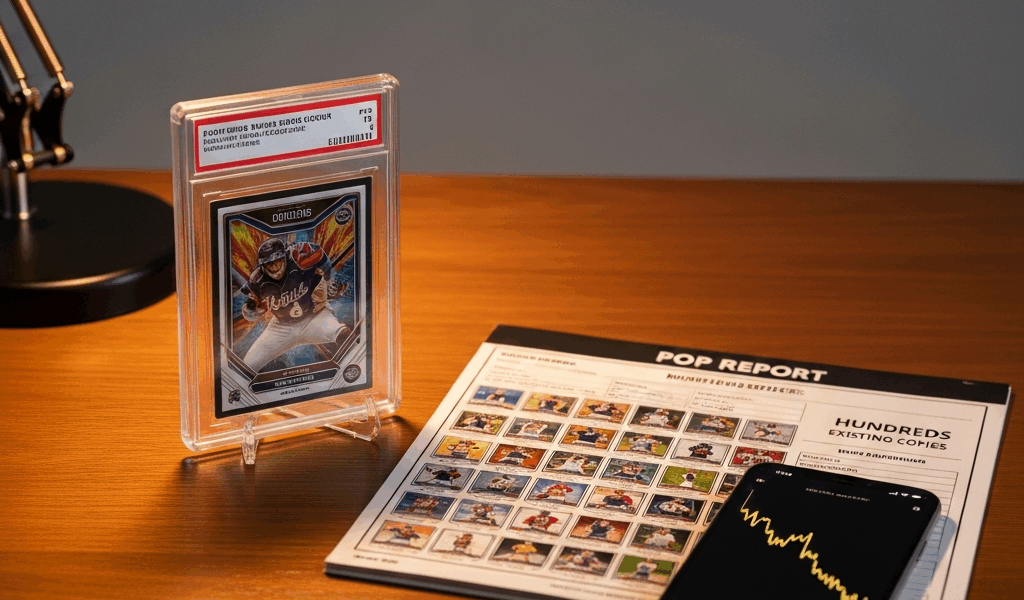
Why Your PSA 10 Card Sold for Less Than Expected
Card collecting has gotten complicated with all the grading hype flying around. Everyone chases the 10. Nobody talks about what happens after you get it.
As someone who has been collecting for twelve years and submitted hundreds of cards personally, I learned everything there is to know about the gap between a perfect grade and a perfect sale. Today, I will share it all with you.
You pulled the card. Sent it in. PSA came back with a 10. You listed it — feeling pretty good about yourself — and watched it sell for 40% below what you had in mind. That stings in a specific way collectors don’t really talk about openly.
Here’s the hard truth: the grade doesn’t create value. The card does. The player does. The timing does. Most grading guides skip this entirely and focus on how to achieve a 10 instead of what to actually do when you get one. So let’s fix that.
The Pop Report Problem Nobody Warns You About
Probably should have opened with this section, honestly.
But what is the Population Report? In essence, it’s PSA’s public database showing how many copies of a specific card have received each grade level. But it’s much more than that — it’s the single most important number standing between your card and a real premium sale.
Every PSA-graded card has a population number. A PSA 10 for a 1986 Fleer Michael Jordan sounds exclusive until you pull up the pop report and find 847 copies already sitting at that level. That’s not a treasure. That’s a commodity with a slab on it.
I learned this the hard way with a 1989 Hoops Michael Jordan. Card looked flawless. Came back a PSA 10. I felt vindicated — right up until I saw 1,247 other PSA 10s of the exact same card already floating around out there. Supply destroys premium pricing. Full stop. When thousands of copies share your grade, you’re not selling something rare. You’re selling one of many. Sales flatten. Sellers start undercutting each other by $5, then $10, then more.
Before submitting anything, check the pop report on the PSA website. Here’s what actually matters:
- Total PSA 10s of that card in existence
- Total PSA 9s — your direct competition on the market
- The ratio between 10s and 9s
- Recent sell-through rates on eBay for PSA 10 copies specifically
Over 500 PSA 10s? Reconsider submission entirely. The grade premium evaporates at that level. A PSA 9 might actually be scarcer — and more valuable — because fewer exist at that tier.
The 2019 Prizm Luka Doncic base card is the textbook case here. Thousands printed. Thousands graded. Pop report shows over 2,000 PSA 10 copies. Despite being a Luka rookie — a Luka rookie — a PSA 10 barely outperforms a PSA 9 in actual sales. The saturation is complete. Your “perfect” card is one of thousands in perfect condition, and every buyer on eBay knows it before they even click your listing.
Player Performance Changed After You Submitted
A PSA 10 freezes condition at the moment of grading. It does not freeze demand. That distinction matters enormously.
Player value moves completely independently of card condition. An injury happens. A suspension drops. On-court numbers start declining. Suddenly your perfect card represents an increasingly distant moment in someone’s career — and the market quietly walks away from it.
I submitted a batch of Vince Carter cards in 2019. He was still playing. Nostalgia for his prime was running hot. Cards came back graded, I priced them for the nostalgia boom — and by 2020, that moment had passed. Not his fault. Time just happens. But my PSA 10s that were built around a specific cultural moment were now selling into a very different one. The cards hadn’t changed at all. The player trajectory had.
This is structural. Unavoidable. That’s what makes timing so endearing to us collectors — and so brutal when we get it wrong.
Check player news before listing. Is your player currently injured? Pull recent reports. Suspended or facing legal issues? The market reacts within hours of that news hitting. Having a down season after serious hype? Check their last ten games and compare those numbers to when you originally submitted. Has a younger player emerged at the same position and stolen the spotlight?
A PSA 10 Kyrie Irving from 2017 was genuinely valuable. Same card, same grade, from 2023 — after his suspension and the Brooklyn situation — was a different story entirely. Condition didn’t change. The career arc did. The market only cares about one of those things.
You Listed It at the Wrong Time on the Wrong Platform
Timing controls everything in card sales. Basketball cards spike during playoff runs and draft season. They crater during the offseason — sometimes dramatically. Football cards move during draft week and training camp, then slow until the playoff push. Baseball cards are almost hyperlocal: a team’s cards jump when that franchise enters contention, sometimes overnight.
Here’s a scenario that plays out constantly. You submitted your Jayson Tatum card in July, after playoff hype faded. It came back in September. You listed in October during preseason, when the broader market was quiet and focused entirely on rookie cup hype. You sold it for $180. That same card moved for $240 in June during the Finals. Same card. Same slab. Different month.
Platform matters just as much. An eBay auction reaches a completely different audience than a Whatnot live auction. PWCC attracts serious high-ticket collectors who will pay real premiums without much friction. Facebook Marketplace attracts local buyers hunting discounts — and they’re proud of it. The same PSA 10 might pull $200 on eBay and $120 on Facebook. I’m apparently a slow learner on this one, and eBay works for me while Facebook Marketplace never quite delivers what I expect.
Don’t make my mistake. Before listing anything, go to eBay’s sold listings filter. Search your exact card. Sort by Most Recently Sold. Look at PSA 10 prices from the last 30 days — not six months ago, not a year ago. The market moves fast. If PSA 10s are clearing at $150 when you expected $250, that’s your number. Either relist at realistic pricing or hold the card and wait for seasonal demand to come back around.
Auction versus fixed price matters too. Fixed price captures the buyer who already knows what they want and will pay a fair number to get it. Auctions can generate competitive energy that pushes price up — or they can end at 11:47 PM on a Tuesday with two bids and a disappointing final number.
The Card Itself Has Less Collector Demand Than You Think
A PSA 10 is a grade. Not a guarantee of value. Not even close.
A 1990 Hoops base card can achieve PSA 10. So can a 1989 Fleer. So can a 2010 Donruss Score. All perfect condition. Not equal products. Hoops from the junk wax era carries a hard ceiling — there were simply too many of these printed between roughly 1987 and 1993. Score carries a lower ceiling. Fleer sits slightly higher. Base cards from these sets have real limits regardless of how clean the slab looks.
Flip to the modern market: a Prizm or Optic PSA 10 from the same player carries dramatically more value than a base card or a low-demand parallel. A Luka Doncic Prizm Base PSA 10 sells consistently. A Luka Doncic Hoops PSA 10 sits. Same player. Completely different set demand. That’s what makes set selection so critical to us collectors who actually want to move product.
Before submitting, research the specific card’s underlying demand independently of any grade. Has this card sold recently on its own merits? How frequently? At what price points with and without a slab? Is it a base card or a parallel with real eyes-on-it potential? Is it from a set collectors are actively hunting, or a set that got quietly abandoned three years ago?
Grade is a modifier. Not a foundation. Your PSA 10 is only valuable if collectors actually want to own it first.
What to Do Before You Submit Your Next Card
So, without further ado, let’s dive in — here’s the actual pre-submission checklist:
- Check the pop report. Over 500 PSA 10s already in existence? Reconsider submission or shift your target to PSA 9, where genuine scarcity might actually exist.
- Pull recent eBay comps. Sold listings only. PSA 10 prices from the last 30 days specifically. This is your realistic market, not the one you’re hoping for.
- Assess player trajectory. Climbing or falling? Injured? Off-court issues surfacing? Grading takes weeks — the player situation can shift dramatically before your card ever comes back.
- Evaluate set demand honestly. Is this set actively collected right now, or has it gone quiet? Base card or a parallel with real collector appeal?
- Run the actual math. Regular grading runs $20 a card. Express runs around $50. If your realistic PSA 10 value sits at $80, you’re losing money on the submission itself — at least if you’re actually trying to turn a profit here.
Not every card deserves a PSA 10. Not every card deserves grading at all. A perfect PSA 10 on the wrong card is still the wrong card — the grade amplifies what’s already there, it doesn’t manufacture value from nothing.
Frustrated by unexpectedly low sale prices, most collectors immediately blame the grading company or the buyer, submitting more cards using the same flawed logic. This new frustration compounds several submissions later and eventually evolves into the hard-won market understanding serious collectors know and live by today.
Your next card will sell for its actual market value. Make sure that number justifies the submission before you drop it in the mail.

Stay in the loop
Get the latest collector sports world updates delivered to your inbox.