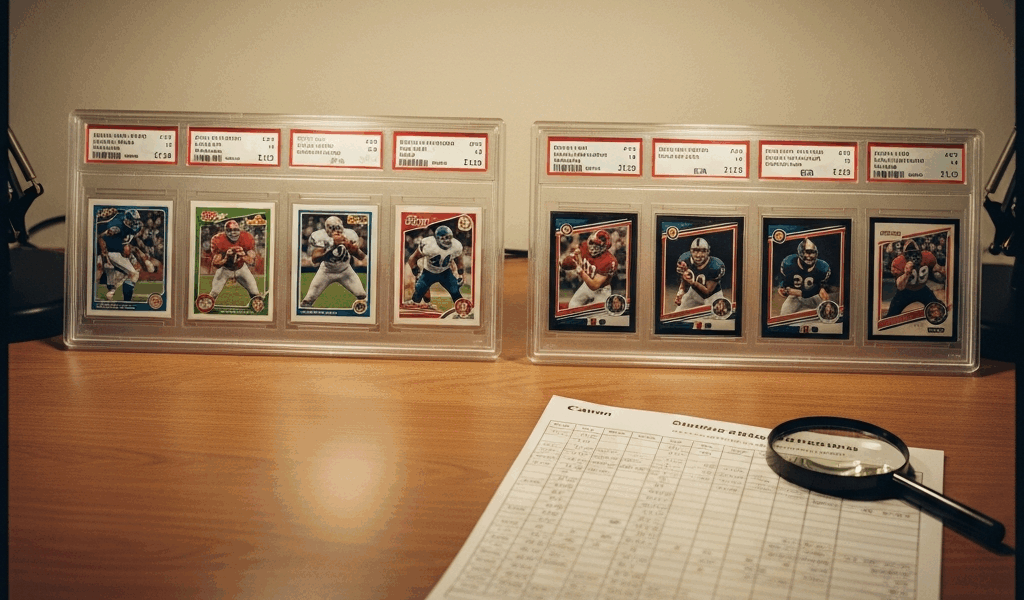
Why Brand Choice Actually Matters for Resale
The Topps vs. Panini football card debate has gotten complicated with all the licensing noise flying around. As someone who lost real money buying a case of Donruss blasters in 2021 — watched every single card sit dead in a binder for two years — I learned everything there is to know about how brand choice actually moves the needle on resale. Today, I will share it all with you.
Brand choice isn’t just aesthetics. It directly controls your resale ceiling. Full stop.
Here’s the licensing situation you need to understand first. Panini held the exclusive NFL license from 2016 through 2025. That meant Topps couldn’t put NFL helmets, team logos, or uniforms on a single football card during that entire window. Topps football became essentially a ghost product — and in a league where collectors care deeply about official branding, that invisibility had consequences. The secondary market noticed harder than the collectors did.
Then Fanatics entered the picture. They acquired both Topps and the NFL licensing rights starting with the 2026 season. That one development reshuffled the entire collector calculus. If you’re buying cards right now without accounting for it, you’re leaving real money on the table.
Print run philosophy also splits these brands sharply. Panini built its reputation on tiered parallel systems — especially in Prizm — where color, print run, and serial numbering create predictable scarcity. Topps Chrome runs a similar parallel ladder. The real difference is how each brand managed overproduction at the base level, which hits resale floors harder than most collectors want to admit.
Topps Football Cards — Where They Stand Now
Surprised by how fast Topps Chrome football generated buzz after its return, I started tracking sold eBay listings for 2024 Topps Chrome rookies in November 2024 — about two weeks after the product hit shelves. What I found was uneven but genuinely promising.
Marvin Harrison Jr. Topps Chrome base rookies were moving between $18 and $35 raw, depending on centering. PSA 10 copies settled in the $90 to $140 range within the first month. Those numbers put them competitive with — though not yet above — comparable Prizm rookies from the same class. Refractor parallels with print runs under 50 pulled $200 to $600 depending on the player. That’s real money for a brand that had zero NFL presence recently.
Collector response on Blowout Cards forums and r/sportscards ran cautiously optimistic. The general read: Topps Chrome has the visual product and the brand recognition, but it probably needs two or three more consistent seasons before Topps rookies become the default benchmark the way Prizm rookies are right now.
One thing working strongly in Topps’s favor — nostalgia capital. Collectors over 35 grew up with Topps as the definitive football card brand. That emotional association translates into real buying behavior, which translates into real upward price pressure. Don’t dismiss it.
Panini Football Cards — Still the Safe Bet or Fading
Prizm rookies are still the benchmark. That sentence deserves to stand alone.
When a player breaks out and ESPN starts running highlight packages, the first card price everyone checks is the Prizm base rookie. Not Select. Not National Treasures. Prizm. That default status took years to build — it doesn’t evaporate in a single offseason just because Panini lost an exclusive deal.
The sets that have held value reliably: Prizm, Select Silver Prizm parallels, and National Treasures autos. The sets that have not held value: Donruss, Illusions, Certified, and most of the mid-tier products Panini pushed during its exclusivity window. Those were largely filler products. Collectors knew it then. Sold comps confirm it now — base Donruss rookies of legitimate NFL starters routinely sell for under $3.
Where things get complicated is saturation. Panini’s production volume during the exclusivity years was enormous. There are a lot of Prizm rookies out there. When Patrick Mahomes or Justin Jefferson cards spike, it’s player-driven demand pulling against significant existing supply — and that supply ceiling limits how high even the best Panini cards can run unless the player hits genuine all-time status.
Signs of softening: Prizm hobby boxes selling for $400 to $500 in 2022 are now moving closer to $200 to $260 on eBay. Some of that is market correction. Some of it is collectors hedging toward Topps. Either way, the trajectory matters if resale is your goal.
Head-to-Head — Rookies, Parallels, and Autos Compared
Base Rookie Resale
Panini Prizm wins this category. Still. A base Prizm rookie of a first-round pick with starter upside moves faster and at higher floors than a base Topps Chrome rookie of the same player — right now the gap runs roughly 30 to 50 percent at raw grades, based on current sold data. That gap will likely shrink over the next two seasons. But if you’re flipping base rookies within 90 days of release today, Prizm is the safer play. No debate.
Parallel Value by Print Run
Topps Chrome wins this one, and it’s not particularly close. The Topps parallel ladder — Refractor, Gold Refractor /50, Orange /25, Red /5, Superfractor 1/1 — has cleaner value escalation than Panini’s color parallel system, which became genuinely confusing and diluted across the exclusivity years. Collectors know exactly what a Gold Refractor /50 is and what it should cost. That clarity drives faster sales and tighter bid ranges. Panini parallels, particularly in lower-tier products, suffer from too many colors with too similar print runs — muddies comparables, frustrates buyers.
Autograph Cards
Split decision here, and honestly player-dependent. Panini National Treasures autos carry an established prestige floor — even low-number rookies from busted prospects hold $80 to $150 raw. Topps Chrome auto Refractors are already competing at similar levels for high-upside rookies. But for quarterbacks and top skill players, NT autos still retain a premium Topps hasn’t matched yet.
Buying autos to hold 12 to 18 months? NT is still the ceiling product. Buying autos to flip within 30 days of a hot rookie performance? Topps Chrome autos are moving with strong velocity right now — precisely because they’re new and generating excitement. Know your timeline before you buy anything.
Which Brand Should You Buy Into Right Now
Probably should have opened with this section, honestly. But context matters, and everything above earns this answer.
Flipping short-term? Buy Prizm. The resale infrastructure is already built. Comps are easy to find. Buyers know exactly what they’re getting. You’re not out there educating the market on every single sale.
Holding long-term — 24 months or more? Topps Chrome is the more interesting bet. The brand is re-establishing itself in a market that’s genuinely hungry for an alternative to Panini’s monopoly-era products. Early Chrome rookies from the first few post-return seasons have real historical value potential — the same way early Bowman Chrome baseball cards from the mid-1990s do now. That was 1996. Those cards matter. Early Topps Chrome football could follow a similar arc.
The player-over-brand principle applies to both sides. A Topps Chrome Superfractor 1/1 of a backup quarterback is worth less than a Prizm base of a rookie who wins Offensive Rookie of the Year. Never let brand loyalty override player evaluation. The manufacturer sets the ceiling — the athlete determines whether you actually reach it.
One actionable move you can make today: before buying anything from either brand, pull the last 90 days of sold eBay listings filtered to completed sales. Not active listings — sellers pad those with wishful pricing. Sort by date, not price. Look for velocity. A card selling 12 times in 30 days at $40 is a better hold than a card with one sale at $90. Velocity tells you the market is real. Don’t make my mistake — that filter alone will save you from buying the wrong brand, the wrong parallel, and the wrong player at exactly the wrong time.

Stay in the loop
Get the latest collector sports world updates delivered to your inbox.