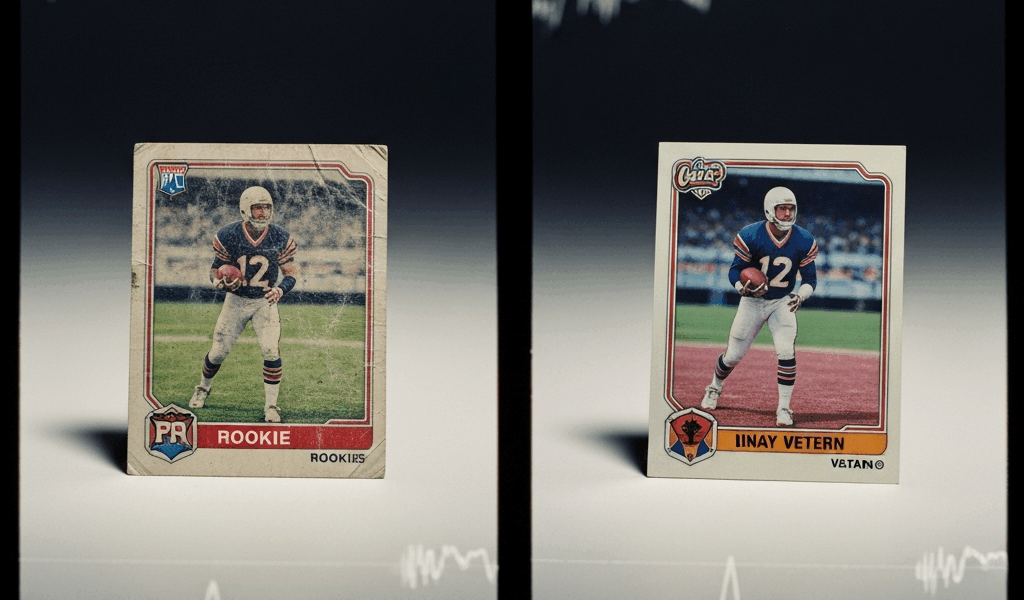
Rookie Card vs Veteran Card — Which One Actually Gains Value
The rookie card vs veteran card debate has gotten complicated with all the misinformation flying around. I spent the better part of 2019 dumping money into high-grade rookie cards thinking they were automatic winners — watched a few flatline completely. Meanwhile, a Brady Super Bowl Champions insert I nearly passed on at $140 tripled by 2021. That experience changed how I think about this. The question isn’t which category is better. It’s understanding exactly when each one wins. Today, I will share it all with you.
Why the Rookie Card Premium Exists
But what is a rookie card premium, really? In essence, it’s the market’s way of pricing singular timing. But it’s much more than that.
The official RC designation — governed by PSA and BGS guidelines — applies only to first-year licensed cards from a player’s initial professional season. That label isn’t decoration. It’s a market signal baked into the hobby’s DNA. There is one rookie year. Everything after is a follow-up. Simple as that.
Patrick Mahomes’ 2017 Panini Prizm RC (#331) has sold in PSA 10 condition anywhere from $800 to over $4,000 depending on market timing and the specific parallel. His Silver Prizm rookie regularly benchmarks above $1,000 in high grade. That card carries weight because it represents one moment — the first widely available licensed card of a future MVP. You cannot manufacture a second one.
Draft class hype also inflates rookie prices in real time. When a top quarterback goes in round one, his Bowman Draft and Prizm rookies spike within hours of the pick. Collectors buying during that initial window are paying for speculation, not proven performance. Some of those bets pay off huge. Some don’t move for years.
- PSA/BGS RC designation is the official standard — not all “rookie year” cards qualify
- First-year scarcity creates a ceiling that veteran cards can never replicate
- Hype windows around draft picks can temporarily inflate prices beyond long-term value
When Veteran Cards Actually Outperform Rookies
Here’s where it gets interesting — and where rookie-first collectors leave real money on the table. That’s what makes veteran card hunting endearing to us long-hold collectors.
Veteran cards win in specific, predictable scenarios. Hall of Fame announcement bumps are among the most reliable. Late-career Kobe autos from sets like 2012-13 Panini Prizm and 2015-16 National Treasures were climbing faster than his Topps Chrome rookie comps on eBay before his passing reshuffled the entire conversation. The reason is population. His rookie cards exist in enormous quantities. A 2016 Panini Flawless Kobe auto numbered to 20? There are maybe a handful in PSA 10. Scarcity wins every time.
Tom Brady is an even cleaner example. His 2000 Playoff Contenders Championship Ticket RC auto (#144/100) is legendary — but it’s notoriously hard to grade well. Centering issues, print defects, the whole mess. PSA 10 examples are rare and expensive. Meanwhile, a 2020 Panini Immaculate Brady auto from his first Tampa Bay season generated serious secondary market action at price points his worn-down RC couldn’t touch in comparable grade populations. Career narrative moments matter.
Short-print autos from peak seasons are the sleeper category. A low-numbered Mike Trout auto from his 2012 Topps Five Star set outpaces many of his base RC comps in PSA 9 — the population is just that thin. Proven legends with championship moments, milestone seasons, or retirement announcements attached to specific veteran cards create buying catalysts that rookie cards simply don’t have access to.
Graded vs Raw — Changes the Math Entirely
Probably should have opened with this section, honestly. Grading is the variable that flips the rookie vs veteran equation more than anything else.
A Mahomes 2017 Prizm RC in PSA 10 is worth multiples of the same card in PSA 9. But the PSA 10 population for that card is in the thousands now. When supply of high-grade copies runs that high, price appreciation slows. The card isn’t rare in top grade — it’s just popular. Those are very different things.
Contrast that with a veteran parallel. A 2019 Topps Heritage Mike Trout Chrome Refractor numbered to 25 — already serialized low — with a PSA 10 pop of two or three copies? That card can move on a single motivated buyer. I’m apparently wired for that kind of hunt, and chasing population outliers works for me while chasing hype windows never really clicked. Population reports tell you the real story.
Older RCs from the late 1980s and 1990s are notorious for centering problems straight from the pack. A 1989 Upper Deck Ken Griffey Jr. rookie in raw condition grades out as a PSA 8 or lower a significant portion of the time — factory cutting inconsistencies, plain and simple. That’s not a reflection of the card’s cultural value. It crushes price potential regardless. Don’t make my mistake. Always check population reports before assuming a raw rookie has a clean path to a 10.
Which Type Fits Your Collecting Style
Two different collectors, two different right answers. So, without further ado, let’s dive in.
The Flip-Focused Buyer
While you won’t need a perfect market crystal ball, you will need a handful of key instincts. Buy during pre-season when a top prospect’s stock is rising, grade quickly, and sell into the frenzy after a strong performance. Focus on skill positions — quarterback, wide receiver, shortstop, point guard — where media coverage drives civilian buying pressure. Burned by sitting on a linebacker’s rookie card that never popped? That’s the risk built into this approach. The upside is real but timing is everything. First, you should sell into strength — at least if you actually want to realize gains rather than watch numbers evaporate.
The Long-Hold Collector
Five-plus year holds? Low-population veteran parallels of confirmed legends might be the best option, as long-hold collecting requires patience paired with research. That is because the value accumulates quietly over time rather than spiking on draft weekend. A serialized auto of a player one strong season away from a Hall of Fame conversation — bought at a reasonable price before any announcement — is where the real money sits. Under 10 copies in PSA 10 for a recognizable name is the target threshold. The PSA population report is your actual research tool here. Use it obsessively.
The Cards That Blur the Line — Prospect and XRC Cards
Prospect and XRC cards have gotten complicated with all the rookie premium confusion flying around. This category deserves a direct warning.
Bowman Chrome prospect autos — think a top MLB draft pick’s first Bowman Chrome autograph — behave exactly like rookie cards in the market. Prices spike on draft day, hype drives buying, PSA grades command serious premiums. But these are not official RC-designated cards. That same player’s Topps Series 1 or Topps Update card in their first MLB season carries the actual RC designation. Different asset entirely.
Frustrated by the gray zone of 1980s cards, collectors have long debated XRCs — Extended Rookie Cards from Topps Traded sets using base card stock and standard print runs. Bo Jackson’s 1986 Topps Traded XRC is genuinely significant but technically predates the current RC designation framework. Collectors treat it as a rookie. The market mostly agrees. PSA will not stamp it with the RC label. That distinction matters when you’re paying real money.
- Bowman Chrome prospect autos — massive market value, no official RC designation
- XRC cards — historically important, but designation rules vary by era
- Minor league licensed cards — typically excluded from RC designation entirely
Always verify the RC designation on PSA’s registry or Beckett’s database before paying rookie-card money. A $300 Bowman Chrome auto is not the same asset as a $300 official RC — even when the market sometimes prices them similarly. Know what you’re actually buying. That single habit will save you hundreds.

Stay in the loop
Get the latest collector sports world updates delivered to your inbox.