PSA vs BGS Grading — Which Service Is Better for Your Cards?
The PSA vs BGS grading debate has followed me for about twelve years now, through three storage units, two marriages (kidding — one), and somewhere north of four thousand cards submitted between the two services. I don’t have a tribal loyalty here. I’ve had PSA 10s that paid for a vacation and BGS 9.5s that sat on eBay for three months with no bites. I’ve also done it backwards — sent cards to the wrong service at the wrong time and watched money evaporate. So when people ask me which grading company is better, I tell them the honest answer: it depends on what you’re holding in your hand, and neither answer is permanent.
What I can give you is a real breakdown — costs, turnaround, resale performance, and the specific scenarios where each company wins. No forum tribalism. Just what I’ve actually experienced submitting cards across both services at volume.
PSA vs BGS — The Core Differences
Start here, because the philosophical difference between PSA and BGS shapes everything downstream.
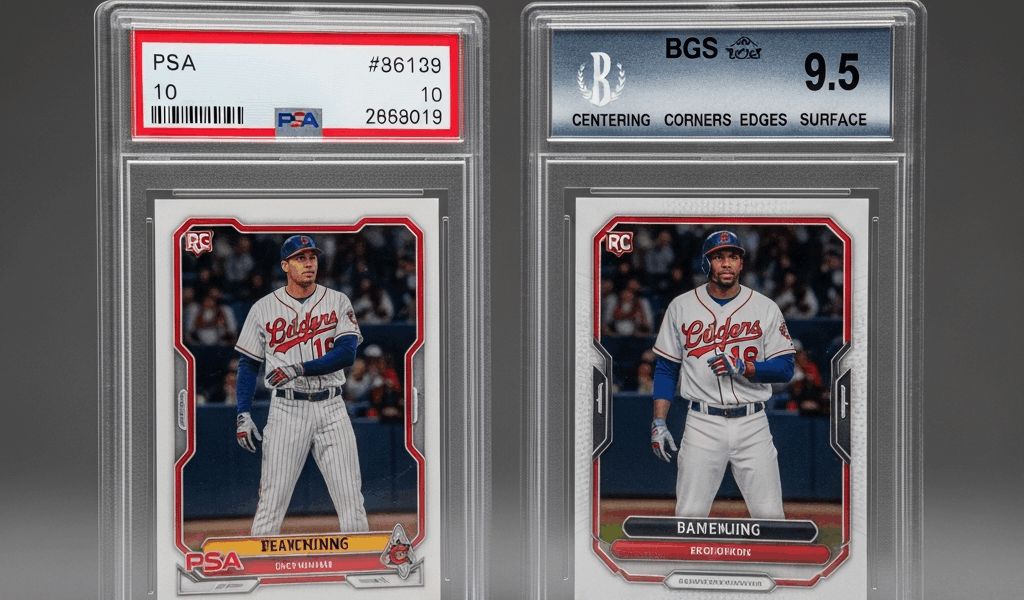
PSA grades on a 1–10 scale and gives you a single number. That’s it. A PSA 10 Gem Mint means the card passed their overall threshold — but you don’t know if the centering was 55/45 front, or if there’s a faint handling mark on the surface that barely squeaked under the limit. The grade is holistic. PSA’s graders are making a judgment call about the card as a complete object, and the final number reflects that call without further explanation.
BGS — Beckett Grading Services — does something fundamentally different. They issue four subgrades: centering, corners, edges, and surface. Each subgrade gets its own score on a half-point scale from 1 to 10. Your final BGS grade is derived from those four components, with the surface subgrade carrying the most weight in practice. A card can come back BGS 9.5 with subgrades of 9.5/9/9.5/9.5 — and suddenly you know exactly where that card lost its points. That transparency is either incredibly useful or mildly depressing, depending on the card.
What Subgrades Actually Tell You
Here’s where BGS gets genuinely interesting for collectors who care about condition analysis. A 9.5 centering subgrade means the card is within BGS’s acceptable front/back ratio — roughly 55/45 or better on front, 75/25 or better on back. If you pull a card that’s clearly off-center, BGS will document it. PSA might still grade that same card a 9 or even a 10 depending on how everything else looks.
Stumbling into my first BGS submission blind, I sent twenty modern rookie cards thinking I’d clean up. Several came back with low surface subgrades I didn’t expect — BGS is notably strict on print defects and factory scratches that PSA sometimes ignores or absorbs into the overall assessment. That batch cost me the submission fees and returned cards I couldn’t sell at a premium. Lesson absorbed, somewhat painfully.
The Slab Itself
Physical difference worth mentioning: PSA slabs are lighter, with a simple red label. BGS slabs are thicker, heavier — about 6mm vs PSA’s roughly 4mm — and come with colored labels that signal grade range. Gold label is a BGS 9.5. Black label is the BGS 10 Pristine, which requires all four subgrades to be 10s. It’s rare. The black label slab is visually dramatic in a way that PSA’s design simply isn’t, which matters when you’re selling to collectors who respond to presentation.
Which Grades Are Worth More at Resale
Probably should have opened with this section, honestly. Most people asking about PSA vs BGS are asking about money. So let’s go there directly.
PSA 10 — The Market Standard
A PSA 10 is the most recognized grade in the hobby. Full stop. eBay’s sold listings tell the story consistently: PSA 10s of mainstream cards — your Luka Dončić Prizm rookies, your Shohei Ohtani Topps Chrome cards, your vintage Honus Wagner reprints — move faster and often higher than BGS equivalents. The PSA population report is widely tracked, and collectors know that a low-pop PSA 10 is a meaningful thing.
For vintage cards especially — pre-1980 baseball, football, basketball — PSA 10 is the benchmark. The vintage community trusts PSA’s authentication more. BGS has historically focused on modern cards, and their population for older vintage material is thin. A PSA 10 1952 Topps Mickey Mantle is a different category of object than almost anything else in the hobby. BGS doesn’t have comparable traction in that market.
BGS 9.5 — The Complicated Middle
BGS 9.5 is tricky. In some markets it commands premiums close to PSA 10. In others it trades at a discount. The difference comes down to the card itself.
For modern ultra-premium cards — Prizm Silvers, Select Concourse, high-end refractors — a BGS 9.5 with strong subgrades (think 9.5/9.5/9.5/9.5 or better) can actually compete with or exceed PSA 10 values on specific cards where the BGS population is lower. The subgrade transparency helps here. A buyer looking at a BGS 9.5 with a 9.5 surface knows more about what they’re getting than they do with a PSA 10.
The problem is consistency. BGS 9.5s with weak subgrades — like a 9.5 overall with a 9 centering and 9 surface — often sell at a noticeable discount to PSA 10. The composite math works out, but the subgrades tell a less flattering story. I’ve watched identical-looking cards — same player, same year, same parallel — split significantly at auction because one was PSA 10 and one was BGS 9.5 with a visible surface subgrade weakness.
BGS 10 Black Label — The Trophy Grade
BGS Black Label 10 Pristine is its own market. All four subgrades must be 10. The population for most modern cards in Black Label is under fifty copies — often under ten. For the right card, a Black Label can absolutely destroy a PSA 10 at auction. I’ve seen Black Label BGS 10s of key rookies sell for three to five times the PSA 10 comparable. The trophy effect is real.
But — and this is a hard but — chasing Black Label is expensive and probabilistic in a way that doesn’t make sense for most submissions. You’re essentially gambling submission fees against a low-probability outcome. For ultra-high-end cards where even a small population boost matters, it can be worth it. For most collectors submitting 100-card lots, it’s not a rational strategy.
The SGC Factor
SGC doesn’t fit the brief’s primary question, but it’s honest to mention: SGC 10 Gold Labels have been punching above their weight in resale on vintage material. For budget-tier grading on lower-value cards, SGC’s $18 economy tier (as of late 2025) beats both PSA and BGS on cost. Worth knowing.
Turnaround Times and Costs in 2026
Both companies have restructured their service tiers multiple times since the pandemic-era backlog disasters of 2021–2022. Here’s where things stand in early 2026, based on my most recent submissions.
PSA Pricing Tiers
PSA’s current service tiers break down roughly like this:
- Economy ($25/card): Estimated 60–90 business days. Realistically, figure three to four months.
- Regular ($50/card): Estimated 20–30 business days. Usually lands around five to six weeks in practice.
- Express ($150/card): Five to ten business days. PSA has generally been meeting this window consistently.
- Super Express ($300/card): Two to three business days. Yes, $300 per card. For cards where a PSA 10 might mean a $2,000+ return, the math works.
- Walk-Through ($600/card): Same-day or next-day at approved shows. I used this once for a card I needed graded before a show floor sale. Not something I do regularly.
One thing PSA does well: their online tracking system has improved significantly. You can watch your order move through receiving, research, grading, and quality control with actual timestamps. The 2021 blackout period where orders disappeared for months has not repeated itself at that scale.
BGS Pricing Tiers
- Economy ($22/card): 60–90 business days. Competitive with PSA at the bottom tier.
- Standard ($30/card): 30–45 business days.
- Express ($75/card): 10–15 business days.
- Premium ($150/card): Five business days.
- Rapid ($250/card): Two to three business days.
BGS is cheaper than PSA at nearly every tier. That $22 economy rate versus PSA’s $25 is marginal, but across a hundred-card submission it’s $300 you keep. The gap widens at express tiers — $75 vs $150 for roughly similar turnaround is a real difference.
Which Is Faster
Neither company reliably beats its estimated windows at economy tier. Both are slower than advertised when volume spikes. My experience submitting at express tier has been slightly more consistent from BGS — I’ve had fewer surprises — but the sample size isn’t large enough to call it definitive. At walk-through and same-day levels, PSA’s show presence is more extensive. BGS attends fewer events where same-day service is available.
When to Use PSA vs BGS
After twelve years of doing this wrong and then right, the decision framework I actually use breaks into three clear categories.
Vintage Cards — Use PSA
Any card printed before approximately 1985: PSA. The vintage collecting community runs on PSA population reports. Authentication carries more weight with pre-war and pre-1970 cards, and PSA has decades of vintage grading history that BGS simply doesn’t match. Trying to sell a BGS-graded 1969 Topps Reggie Jackson rookie into the vintage market is fighting the current. The buyer pool expecting PSA is larger, the comps are more established, and the resale friction is lower.
Burned by this lesson firsthand: I sent eight 1970s Topps football cards to BGS in 2019 because BGS was running a promotion. They graded fine. Took me eight months to move them all, at prices below what equivalent PSA grades were pulling. Never again for vintage.
Modern Premium Cards — Consider BGS
For cards from approximately 2015 onward — especially high-end Prizm, Optic, Select, and Topps Chrome parallels — BGS makes a strong case when you believe the card can hit strong subgrades. The subgrade transparency rewards cards that are genuinely pristine across all four axes. If you’re pulling a card from a fresh pack, handling it with gloves immediately, and it looks absolutely flawless under a loupe, BGS gives you the framework to demonstrate that perfection. A BGS 9.5 with all 9.5 subgrades is a more credible “near perfect” claim than a raw PSA 10.
The caveat: BGS surface grading is strict on factory imperfections. Modern cards often have print lines, roller marks, or micro-scratches from the factory that PSA absorbs more readily. Test the waters with a small submission before committing a full case.
Budget Grading — Neither, Actually
If the card’s ungraded value is under $40, grading with PSA or BGS at any tier rarely pencils out financially. The economics only work if the grade significantly multiplies the card’s value — which generally requires either a PSA 10 or a BGS 9.5 on a card with meaningful collector demand. For bulk commons and mid-tier players, SGC’s economy tier is the move, or don’t grade at all and sell raw.
The Honest Tiebreaker
Here’s what it comes down to when I’m standing at my submission table with a card I’m genuinely unsure about: Who is buying this card likely to be, and what do they expect to see? If the answer is “a vintage collector who grew up with PSA,” send it to PSA. If the answer is “a modern collector who wants proof of condition across all four dimensions,” BGS earns the submission. Market alignment matters more than personal preference.
Neither service is universally better. PSA wins on market breadth, vintage credibility, and recognition. BGS wins on pricing, subgrade transparency, and premium modern presentation. The collectors who figure this out early spend less money chasing the wrong audience with the wrong slab.


Stay in the loop
Get the latest collector sports world updates delivered to your inbox.