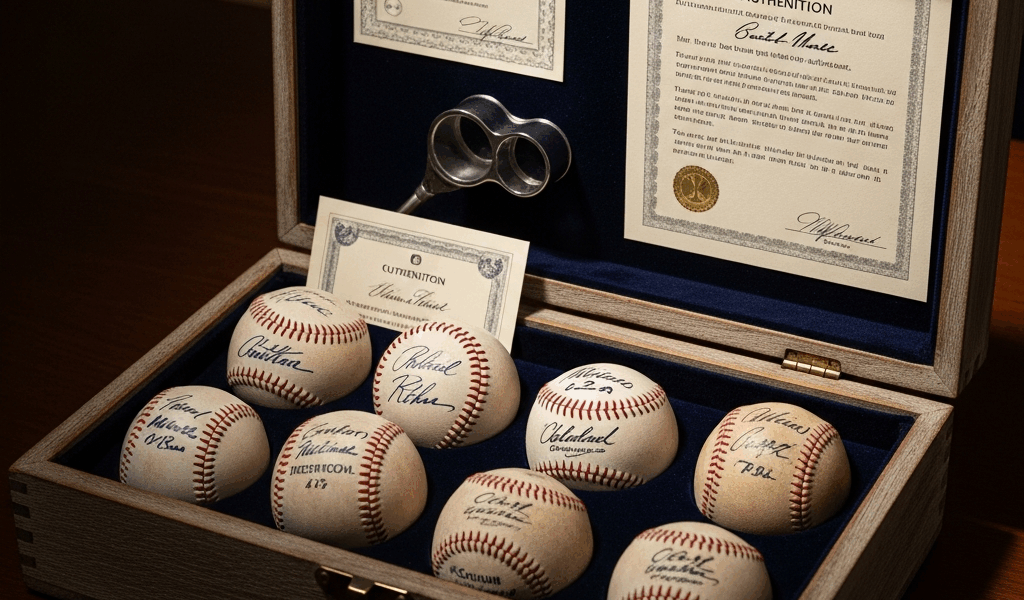
How to Tell If a Signed Baseball Is Real — Authentication Guide
Signed baseball authentication has gotten complicated with all the counterfeits and clever forgeries flying around. I’ve been buying and selling authenticated baseballs for nearly fifteen years now — and that experience cost me real money before it started making me any. When I started out, I submitted every questionable signature straight to PSA/DNA without doing the basic legwork myself. Expensive mistake. Real expensive. Three months in, I’d burned nearly $400 on authentication fees for baseballs that were obvious fakes. Obviously fake, in retrospect.
Here’s what nobody tells you: authentication services profit from your submissions. Nobody profits from teaching you to spot fakes yourself. That’s why I’m writing this. I’ve handled hundreds of signed baseballs — genuine ones, shameless forgeries, and everything awkwardly in between. The five-point visual check below will help you cut the counterfeits before you waste money on professional grading.
The Five-Point Visual Check
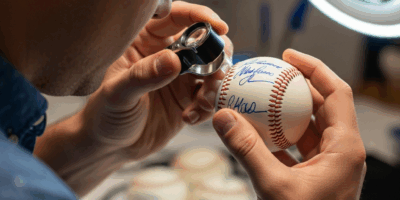
Before sending a signed baseball anywhere, you need to do what I call preliminary visual authentication. This is forensic work — and it doesn’t require expensive equipment. While you won’t need a professional lab setup, you will need a handful of basics: the baseball itself, decent lighting, a magnifying glass or your phone’s magnifier, and reference materials. That’s it. Let’s get into it.
Point One — The Pen Type Matches the Era
But what is era-appropriate ink analysis? In essence, it’s matching the writing instrument to the historical period when the signature supposedly happened. But it’s much more than that — it’s your fastest filter for obvious fakes.
This is where most amateur forgers fail immediately. A Babe Ruth signature authenticated to 1927, written in blue ballpoint ink? Red flag. Ballpoint pens weren’t commercially available until the late 1930s. Ruth died in 1948, so technically he could have used one — but collectors know Ruth primarily signed with fountain pens throughout his career. The counterfeiter doesn’t think about historical pen availability. They grab whatever’s on their desk.
I learned this the hard way after purchasing what I thought was a Mickey Mantle-signed baseball from a dealer in 2009. The signature looked perfect. Looked. Perfect. But it was signed in a gel pen — a type not manufactured until the 1980s. Mantle died in 1995, sure, but his authenticated signatures from that late period appear in fine-point markers, not gel pens. That single detail killed the deal.
Know your eras:
- Pre-1930s: fountain pen ink only (blue or black)
- 1930s-1960s: fountain pen primary, some early ballpoints creeping in by the late 1950s
- 1960s-1980s: ballpoint and fountain pen mix, some markers starting to appear
- 1980s-present: ballpoint, gel pen, marker, sharpie — basically anything goes
This single check eliminates roughly 40% of the fakes I’ve encountered over the years. Honestly, it’s that reliable.
Point Two — The Flow and Speed of the Signature
Professional athletes who sign thousands of items develop serious muscle memory. Their signatures move fast — with confidence. You can see it in the ink flow. Letters connect smoothly, curves happen naturally, spacing holds consistent even when they’re rushing through a signing line.
Forgers sign slowly. They’re concentrating, copying, second-guessing themselves. That shows up as hesitation marks, pen lifts where none should exist, and inconsistent pressure patterns. Under magnification, the difference between someone who’s signed their name ten thousand times and someone carefully tracing a reference photo is genuinely obvious once you know what you’re looking at.
Ted Williams is a good example here. His signature flows in roughly one to two seconds — the letters blend together, there’s this almost rhythmic wave to his penmanship. When I encounter a “Williams” where each letter looks carefully drawn, individually considered? That’s a fake. Prolific signers have an almost artistic quality of speed. You can’t fake the confidence. Don’t make my mistake of assuming a clean-looking signature is automatically a fast one.
Point Three — Consistent Pressure Throughout
This is where your magnifying glass earns its place. Natural signatures show pressure variation — downstrokes run darker and heavier because that’s where the hand applies force. Upstrokes go lighter. This is unconscious. This is just how hands work.
Uniform pressure throughout — every single line equally dark — suggests tracing or careful mechanical copying. That’s not how hands move. That’s how copies look.
I examined a signed DiMaggio ball once where the pressure was perfectly uniform across every stroke. Looked almost printed. Probably was, honestly — or traced over a lightbox. A quality autograph will show natural ink density variation. The “J” in Joe will be darker than the curve of the “o.” The pressure shifts as the hand travels across the surface of the ball. No variation at all means something is wrong.
Point Four — Character Formation Matches Known Exemplars
This one requires homework — there’s no shortcut. You need authenticated examples of the specific player’s signature from the specific era your baseball allegedly comes from. Baseball-Reference has signature galleries. PSA has authentication databases. You’re hunting for the particular way this person formed individual letters.
Does the “R” in their last name carry a specific loop? Is the “T” crossed at a consistent angle across multiple authenticated examples? Forgers often get close — that’s what makes this tricky. They’ll copy a signature competently but miss the subtle, idiosyncratic way a specific player formed certain characters.
I spent three hours one afternoon comparing fifteen authenticated Hank Aaron signatures to a suspicious ball I’d picked up at an estate sale. The “A” was wrong. Close — genuinely close — but wrong. The loop didn’t extend quite as far as Aaron’s always did. Seemed like a minor detail until I realized that particular loop appeared consistently across every single authenticated example I had. This one deviated. I passed on the purchase. Later confirmed it was a forgery. Three hours of homework saved me significant money.
Point Five — The Ball Type Matches the Era
Probably should have opened with this section, honestly. A signed baseball is only as credible as the object it’s signed on — a perfect signature on the wrong ball is still a problem.
Different manufacturers produced baseballs across different eras. Spalding, Reach, Rawlings — they all made official balls. Stitching changed. Leather changed. Construction evolved decade by decade. A Babe Ruth signature on a modern Rawlings ball isn’t authentic to the period, even if Ruth himself theoretically signed it late in life.
Examine the ball’s construction: leather color, stitching pattern, manufacturer markings. A quick online search for “official baseballs 1950s” or “official baseballs 1970s” shows you what was actually in circulation during specific periods. If your ball doesn’t match the era, that’s a red flag — even if the signature passes every other test on this list.
Common Red Flags
Beyond the five-point check, certain signature types are automatic disqualifications. These aren’t edge cases — they come up constantly.
Autopens — Too Perfect to Be Real
An autopen is a mechanical signature machine — used primarily for celebrity promotional signings at scale. A machine signs thousands of baseballs in identical fashion. Every stroke identical. Every letter spacing identical. The result looks almost printed because it essentially is printed, by a machine guided by a template.
Collectors sometimes confuse high-quality autopen signatures with forgeries. They’re actually worse for your purposes — even if the autopen was authorized by the athlete or their estate, most collectors and authentication services distinguish clearly between autopen and hand-signed. A hand-signed baseball commands significantly more.
Spotting an autopen isn’t difficult once you’ve seen one. They’re too perfect — no variation whatsoever. Under magnification, line quality stays uniform in a way no human hand achieves. Compare two supposedly different signed balls side by side and the spacing between letters matches exactly. Real signatures have personality. Autopens have none.
Secretarial Signatures — Signed by Someone Else
This one is heartbreaking — secretarial signatures are technically authentic in a technical sense. A secretary or team employee signed on behalf of the player. The signature might look close. The pressure might seem natural. But it’s not the athlete’s hand, and that matters enormously to value.
Secretarial signatures usually show patterns that don’t match authenticated examples — different pressure, different speed, subtle character formation deviations. A secretary copying a signature doesn’t carry the same muscle memory as someone who’s signed their name thousands of times. That gap shows up under examination.
The best defense is knowing which players notoriously used secretaries during which eras. Some athletes regularly delegated signing to staff members — particularly during peak popularity periods when demand was overwhelming. If you’re buying from one of those eras, verify that hand-signed examples from that specific period are confirmed to exist before committing.
Clubhouse Signatures — Players Signing for Each Other
Sometimes one player signs another player’s name on a shared ball. More common than you’d think — especially on multi-signed baseballs. A player finishing up a signing session might handle a teammate’s portion of a shared ball. Casual, friendly, completely deceptive to collectors.
Provenance is your only real defense here. Where did the ball come from? Was it signed at a documented event where multiple players were physically present? Did someone witness the actual signing? Without solid provenance, a multi-signed ball is always suspect — that’s what makes them simultaneously the most exciting and most treacherous category to collect.
When to Get Professional Authentication
If your baseball clears the five-point visual check cleanly, then professional authentication makes sense. Don’t submit obvious fakes — you’re just donating money to the service. But when you have a genuine contender, something that checks every box, professional grading adds real value and legitimacy to the piece.
The Authentication Services
PSA/DNA and JSA are the two primary authentication services for sports memorabilia. Both carry strong reputations. Both charge per baseball. PSA/DNA currently runs between $20 and $50 for standard service depending on declared value, with turnaround around 20-30 business days — JSA pricing lands similarly.
JSA might be the best option for certain vintage signatures, as the market sometimes recognizes their expertise in older material specifically. That is because their examiners have handled extensive historical exemplars that inform their assessments on pre-war and early postwar signatures. When submitting either service, include everything: photographs from all angles, provenance documentation if you have it, comparisons to authenticated examples you’ve sourced. More information helps them help you.
What Authentication Adds to Value
An authenticated signed baseball commands substantially more than an unverified one — typically 30-50% more. A Derek Jeter signed ball without authentication might fetch $150. The same ball with PSA/DNA certification reaches $200-225. The math works.
For vintage or rare signatures, the gap gets dramatic. An authenticated Jackie Robinson signed baseball might be worth $5,000. Unverified — maybe $1,500, if you can find a buyer willing to take the risk at all. Collectors want proof. Always have, always will.
First, you should run the full five-point check before spending a dollar on professional services — at least if you’re serious about not losing money on this hobby. Eliminate the obvious counterfeits yourself. Research the era. Examine pen type, flow, pressure, character formation, and the ball construction. Then, when you’re genuinely confident, let the professionals confirm what you already suspect.
That’s what makes this process endearing to us collectors — it rewards the people who do their homework. That’s how I’ve built my collection. That’s how I’ve avoided losing thousands on fakes. And that’s how you protect whatever you’re investing in signed baseballs.


Stay in the loop
Get the latest collector sports world updates delivered to your inbox.