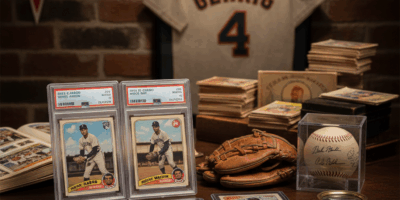
Card centering has gotten complicated with all the different grading company standards and measuring methods flying around. As someone who’s submitted hundreds of cards and learned the centering game through expensive trial and error, I learned everything there is to know about what makes or breaks a grade. Today, I will share it all with you.
Why Centering Matters So Much
That’s what makes centering endearing to us collectors chasing high grades — it’s often the difference between a PSA 9 and PSA 10. A card with perfect corners, edges, and surface can still get knocked down a full grade for centering alone.
The price difference between grades is dramatic. A card worth $500 in PSA 10 might be $100 in PSA 9. Centering is worth understanding.
Understanding Centering Ratios
Centering is expressed as ratios like 60/40 or 55/45. This measures how far off-center the image is from the card borders.
- 50/50 – Perfect centering
- 55/45 – Excellent, usually qualifies for 10
- 60/40 – Good, might get 10 at PSA, borderline at BGS
- 65/35 – Acceptable for 9 at most companies
- 70/30 or worse – Gets noted, can drop grades significantly
Measuring Centering Yourself
Probably should have led with this section, honestly. You can measure centering before submitting with a millimeter ruler or centering tool.
Here’s the process:
- Measure the left border width in millimeters
- Measure the right border width
- Convert to ratio (if left is 3mm and right is 2mm, that’s 60/40)
- Repeat for top and bottom
- Both dimensions matter for the grade
Tricks That Help
Some tips from experience:
- Buy graded references – See what PSA 10 centering looks like for specific sets
- Use a loupe – Small border differences are easier to see magnified
- Compare edges of design elements – Some cards have graphics that make judging easier
- Check both sides – Centering is measured on front and back
When Bad Centering Doesn’t Matter
For vintage cards, standards relax. A 1952 Topps Mickey Mantle with 70/30 centering can still command massive prices. The scarcity overcomes the flaw.
For raw cards you’re keeping, centering is aesthetic preference only. Not everything needs to be submission-worthy.
Factory Issues to Know
Some sets are notorious for centering problems:
- 1980s Fleer baseball often cuts poorly
- Early Prizm football had frequent issues
- Certain Topps years show consistent patterns
Research the set before expecting gem mint examples. Some cards barely exist with proper centering.