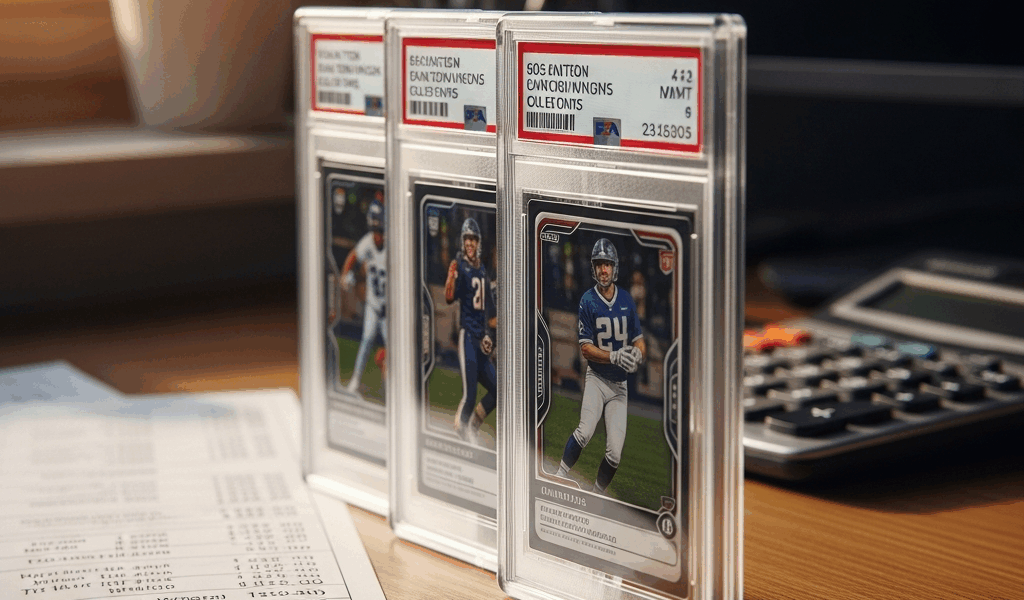
BGS vs PSA vs SGC Graded Cards Resale Value
Which Graded Slab Actually Sells for More
Graded card resale value has gotten complicated with all the slab loyalty noise flying around. As someone who has submitted hundreds of cards across all three major graders, I learned everything there is to know about how BGS, PSA, and SGC actually perform at resale. Today, I will share it all with you.
Here is the short version: PSA 10s move faster and sell for more money on the vast majority of cards. That is not a hot take — it is what sold listings on eBay and PWCC show, repeatedly, across categories. A BGS 9.5 Black Label is the one real exception, and it is a meaningful one on the right cards. But for most collectors trying to flip or liquidate, PSA wins the liquidity race. Wide margin. Not close.
Put some numbers behind it. A 2018 Topps Update Shohei Ohtani RC PSA 10 has consistently sold in the $180–$240 range on eBay over the last 12 months. The BGS 9.5 counterpart — without a Black Label — hovers around $90–$120. Same card. Different slab. Roughly half the price. That gap is real, and it matters enormously if you are making submission decisions with resale in mind.
Now, the BGS 9.5 Black Label is a different animal entirely. That means all four subgrades came back as 10s. Those have cleared $400–$500 on the same Ohtani when they surface — which is rare. Rarity is the entire point. Scarcity plus the prestige of four perfect subgrades creates a ceiling PSA 10 simply cannot touch on premium modern cards. But that upside only exists for a small percentage of submissions. A small percentage.
Everything else in this article flows from that basic framework. PSA dominates on volume and liquidity. BGS Black Label wins on ceiling. SGC holds a specific niche. So, without further ado, let’s dive in.
How PSA Graded Cards Perform at Resale
PSA controls somewhere between 70–75% of the third-party grading market by submission volume — at least according to most estimates floating around the hobby. That market share translates directly into buyer behavior. When someone searches “Luka Doncic Prizm PSA 10” on eBay, they are not cross-shopping BGS and SGC versions as equals. PSA 10 is the default entry point. Search intent is built around PSA in a way it simply is not built around the other two.
Part of that dominance comes from the PSA Set Registry. Collectors chasing completed sets inside the registry have a structural reason to pay premiums for PSA-graded copies specifically. Registry competition drives demand independent of the underlying card. That is a real buyer pool BGS and SGC do not have in the same way. It is a moat, honestly.
There is also a grading standards conversation worth having. PSA grades are generally considered slightly more generous than BGS on centering and surface play. A card that earns a PSA 10 might come back as a BGS 9 or 9.5. That matters for resale in two directions simultaneously — higher PSA 10 pop counts reduce scarcity, but buyers staying confident they can hit a 10 with PSA keeps submission volume and market liquidity high. Both things are true at once.
Don’t make my mistake. Early on I submitted a batch of 2020 Topps Chrome Julio Rodriguez prospects to BGS because I liked the look of the case — I’m apparently an aesthetics guy, and Beckett’s black label case works for me while PSA’s plain holder never felt as satisfying. Several came back as 9.5s. Not bad grades. But I left real money on the table because PSA 10 comps on those same cards were running 60–80% higher at the time. Lesson learned the hard way, at roughly $340 in foregone value across six cards.
How BGS and SGC Graded Cards Compare on the Market
But what is BGS’s actual advantage? In essence, it’s the subgrade system. But it’s much more than that.
When you are buying a BGS-graded card, you know exactly what the grader thought of centering, corners, edges, and surface — individually, broken out. A BGS 9 with a 9.5 centering and three 9s elsewhere is a very different card than a BGS 9 with an 8 on surface. PSA gives you nothing that granular. Zero.
Burned once by a BGS 9 that looked objectively better than a PSA 10 I had paid double for, I started using subgrades as a serious buying signal. They are genuinely useful for that purpose. But — and this is critical — that benefit accrues to buyers and personal collection builders, not necessarily to sellers trying to maximize resale value.
The BGS Black Label is real upside, not marketing. On high-value modern cards — think Wander Franco, Julio Rodriguez, Adley Rutschman rookie chrome — a Black Label commands meaningful premiums over PSA 10 when it surfaces in an auction. The challenge is hitting it. Every subgrade must come back as a 10, which happens on a small percentage of submissions even for near-perfect raw cards. You cannot plan around Black Label. You can only hope for it.
SGC is a different story. Frustrated by BGS and PSA’s inconsistent vintage turnaround times during the 2020–2021 submission boom, many vintage collectors moved to SGC — and stayed. The 2020 rebrand improved their case design significantly, and pre-war collectors have responded. T206s, early Topps and Bowman sets — SGC has a loyal following in those categories specifically. Their grading standards on vintage are well-regarded, and the case holds up well over time. On a 1952 Topps Mickey Mantle, an SGC 5 is a legitimate comp to a PSA 5 for many vintage buyers. That is simply not true across the board on modern cards, where SGC still lags PSA significantly in buyer recognition and search demand.
When It Makes Sense to Choose BGS or SGC Instead
Probably should have opened with this section, honestly — because the real question is not which slab is “best” overall. It is which submission decision makes sense for a specific card in a specific situation. That framing changes everything.
Submit to BGS when all of these are true:
- The card is a modern star rookie in a premium chrome or refractor product
- The raw card is genuinely pristine — four-corner sharp, perfect centering, no print lines visible under a loupe
- The Black Label upside would meaningfully change the card’s value tier — meaning the underlying card is already worth $100+ in lesser grades
- You are comfortable holding longer if the card grades as a BGS 9.5 non-Black Label rather than flipping immediately
Submit to SGC when:
- The card is vintage — roughly pre-1980 — and PSA’s current turnaround or tiered pricing makes the economics difficult
- You are grading for a personal collection where SGC’s case and standards suit your preference
- The card falls into a category where SGC has established comps and buyer demand — T206, early Topps, vintage star commons
Submit to PSA for everything else. Modern base, rookies you want to move in 30–60 days, mainstream sports cards where buyer search behavior is PSA-first — PSA wins that decision on liquidity alone. The premium you will realize at resale outweighs the slightly higher submission costs at most tiers. I submit to PSA’s Value tier at $25 per card for most modern commons and it pencils out almost every time.
What This Means When You Are Buying Graded Cards
Flip the perspective and the math gets interesting. That’s what makes the grading slab conversation endearing to us collector-types — the answer genuinely changes depending on which side of the transaction you are on.
Buying for a personal collection with no intention of reselling? A BGS 9.5 is frequently the better purchase. You are getting a card a strict grader evaluated to near-perfection — four individual subgrades visible, you know exactly what you have — and you are often paying 30–50% less than a PSA 10 of the same card. Real savings for PC collectors who care about card quality over slab recognition.
Driven by budget constraints while building a Shohei Ohtani collection in 2022, I started targeting BGS 9.5s specifically as PSA 10 alternatives. Paid significantly less on each one — roughly $80–$110 per card versus $180+ for PSA 10s at the time. The cards look excellent in the case. Zero regrets for collection purposes. I’m apparently a value-oriented collector at heart, and BGS 9.5 works for me while chasing PSA 10s never made financial sense on a collector’s budget.
SGC slabs bought for vintage personal collections are a similar story. The cases are solid, the grading is respected in the hobby, and you are not paying the PSA premium that sellers chase because of brand recognition. If you never plan to sell, that premium is just noise.
Here is the bottom line: PSA 10 is the right answer if you care about resale speed and price on mainstream modern cards. BGS Black Label is the ceiling-play for pristine high-value modern submissions. SGC is the legitimate choice for vintage. Buying for a personal collection — flip the logic entirely. BGS 9.5 and SGC slabs let you own comparable quality at a meaningful discount. Pick the path that matches what you are actually trying to accomplish, not the one that sounds most prestigious on a forum post.

Stay in the loop
Get the latest collector sports world updates delivered to your inbox.