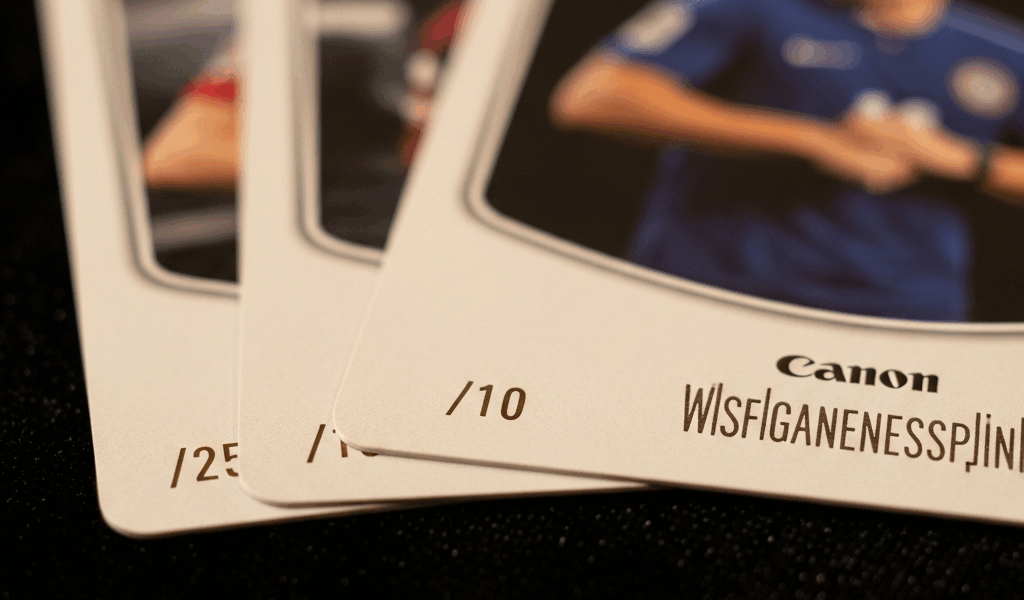
What the Number After the Slash Actually Means
Serial numbered cards have gotten complicated with all the misinformation flying around. So let me break this down in plain terms. When you see a card marked 47/99, that’s telling you something exact: that card is the 47th copy out of 99 total copies ever printed. Not approximately 99. Not “around” 99. Exactly 99 — and yours is number 47.
But what is serial numbering, really? In essence, it’s a production guarantee stamped directly onto the card. But it’s much more than that. Each of those 99 cards carries a unique number from 1 to 99. Card 47 is not card 48. Card 1 is not card 99. No two cards in that entire run share a number. Ever.
Think about numbered prints in fine art. A lithograph marked “Edition 47 of 250” means the artist produced exactly 250 copies — your print is the 47th pulled off the press. Lower numbers come earlier in the production run, but honestly, that’s just trivia. What carries real weight is the denominator. That 250. That’s the print run. That’s the scarcity marker.
In card collecting, the denominator is everything. A /99 means 99 exist. A /25 means 25 exist. A /1 means one was ever made — full stop. The numerator? Mostly just your inventory tracker. Probably should have opened with this section, honestly. Too many beginners obsess over holding number 12 versus number 87 when the real question should always be: out of how many?
How Print Run Size Changes What a Card Is Worth
Same player. Same photo. Same card base. One is numbered /99 and another is numbered /25. The /25 will almost always cost more — sometimes significantly more.
Scarcity drives price. That’s not complicated economics. It’s just supply and demand playing out across a spreadsheet. If you’re selling a LeBron James rookie parallel and you can list either a /99 copy or a /25 copy, the /25 generates more bidding interest. Fewer copies exist. Fewer collectors can own one. The price climbs.
I learned this the hard way about three years ago. Picked up a Jayson Tatum parallel numbered /199 for $85, thinking I’d flip it for a quick profit. Two weeks later, I watched the identical card — same set, same year, same pose — in a /75 version sell for $180. I’d bought the wrong tier. That print run difference was 124 cards, and it cost me roughly $95 in opportunity cost. That stung. Don’t make my mistake.
Here’s where most collectors land mentally when it comes to print run thresholds:
- Print runs under 50 command a genuine premium
- Print runs under 10 jump into “chase card” territory with noticeably steeper prices
- Anything /1 — a true 1-of-1 — lives in its own valuation universe entirely
But here’s the trap. Beginners assume low print run automatically equals high resale value. It doesn’t. A /25 copy of a mediocre bench player’s rookie card still won’t generate auction interest just because it’s rare. The player has to matter. The design has to matter. Condition has to matter. Scarcity amplifies value for desirable cards — and amplifies stagnation for forgettable ones.
I’ve watched collectors assume that a card numbered /10 holds value regardless of corner wear or centering issues. Then they list it, get zero offers, and wonder why. A pack-fresh, gem-mint /25 will outsell a beat-up /10 every single time. Rarity doesn’t erase the grading rules. Not even close.
Why 1-of-1 Cards Are in a Category of Their Own
A 1-of-1 card occupies a strange space in the hobby. It’s the rarest thing you can own — by definition, nobody else has an identical copy. Yet that extreme scarcity can actually make it harder to move.
True 1-of-1s include Superfractors — those holographic parallel variants Panini produces — printing plates (the actual metal plates used during production), and logoman patches, which are cards embedded with a cut piece of the team’s jersey logo. These aren’t serial numbered /1 out of some planned run of 5,000. They’re genuinely singular objects. One exists. That’s it.
Because they’re unique, pricing becomes auction-driven rather than comp-driven. You can’t look up five recent sales of “identical” 1-of-1s — there are no identicals. So collectors and sellers resort to auction houses, Instagram DMs, and private deals done quietly. The prestige is real. The buyer pool is tiny.
I watched a Superfractor 1-of-1 from a recognizable player sit on the market for eight months before finally moving — not because it lacked value, but because the only person willing to justify that price point had to genuinely want it badly. A /50 version of the same base card sold in two weeks at a lower price. Accessibility beats prestige when it comes to resale velocity. That’s what makes the 1-of-1 market endearing to serious collectors — and maddening to anyone trying to flip fast.
If you’re buying a 1-of-1, ask yourself honestly: are you buying to flip, or buying to keep? The answer changes everything. Flipping 1-of-1s is slow, uncertain work. Holding them is sometimes the only realistic exit strategy.
Mistakes Collectors Make When Buying Serial Numbered Cards
New collectors stumble in predictable ways the first time they encounter print run numbering. So, without further ado, let’s dive in.
Mistake One: Overpaying for a /99 when a /199 exists at the same price. Sometimes the market hasn’t caught up. Both sitting around $40 — but the /99 should realistically command 15 to 25 percent more. If it doesn’t, you’ve spotted inefficiency. Buy the /99. If the /199 is priced identically to the /99, that’s a red flag that neither is moving — walk away from both.
Mistake Two: Confusing auto-numbered parallels with non-auto versions. Some parallel tiers run low because they’re hit odds — maybe 1 per 500 packs. Others are intentionally short-printed /25 runs by design. The numbering looks identical on the card. The cachet is completely different. Check the official set checklist before buying — Panini, Topps, and Upper Deck all publish documentation that distinguishes random pulls from fixed print runs.
Mistake Three: Assuming a /50 blue parallel is rarer than a /75 red parallel because blue looks better. I’m apparently drawn to aesthetics myself and once made exactly this call — the blue looked cooler while the red never caught my eye — but the red is objectively 33% more available. If pricing isn’t reflecting that reality, something’s off. Make the data do the talking.
Mistake Four: Treating low print run as a guarantee of resale value. A /25 of a third-string linebacker’s rookie card will not sell well. Ever. Print run is one variable among several. Player relevance, card design, and current market demand matter just as much — sometimes more.
How to Use Print Run Numbers to Make Smarter Buys
While you won’t need a finance degree or a professional grader on speed dial, you will need a handful of research habits before spending real money on any serial numbered card.
First, you should verify the parallel tier and confirm its print run on the official set checklist — at least if you want to avoid overpaying by $30 on a card that’s worth $18. Panini, Topps, Upper Deck — all three publish detailed documentation. Ten minutes of research prevents ten-dollar mistakes.
Second, filter eBay’s Sold listings by the exact denomination. Type “2020 Topps Chrome /50 refractor” plus the player’s name into the sold listings search. You’ll pull five to fifteen real comps of that specific card in that specific tier. Look at price, condition, and sale date. Anything older than 60 days is stale data — the hobby moves fast.
Third, scale your research to the stakes. A /500 parallel? Eyeball it and move on. A /10? Pull the comps. A /1? Talk to a dealer first or get a formal appraisal. The lower the print run, the more critical the research becomes before making any offer.
Fourth, condition grades matter as much as print run numbers. A PSA 8 on a /25 will frequently underperform compared to a PSA 9 on a /50. Rarity might be the best differentiator in a crowded market, as serial numbering requires real scarcity to drive value — but that’s because condition fundamentals never stop applying, regardless of how rare the card is.
Serial numbered cards explained comes down to this: the number after the slash tells you exactly how many copies exist. Fewer copies means higher potential value — but only when the card itself is worth chasing. Use that print run as one variable among several, check it against real sales data, and you’ll stop bleeding money the way beginners consistently do when they skip this step entirely.

Stay in the loop
Get the latest collector sports world updates delivered to your inbox.