Beckett vs PSA Grading Costs — What You Actually Pay
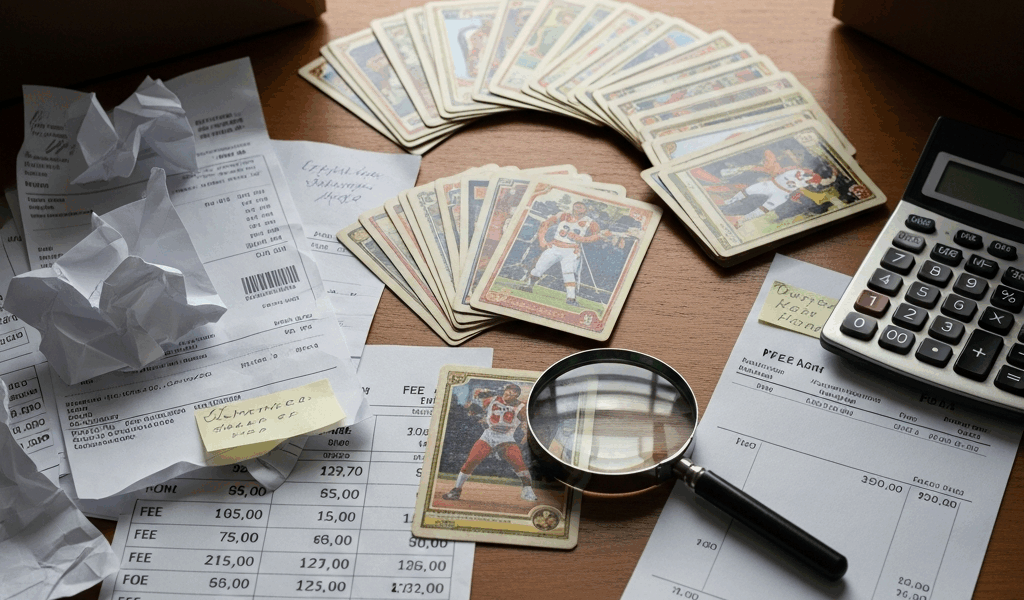
Beckett vs PSA grading costs have gotten complicated with all the conflicting breakdowns flying around. As someone who sent in 15 cards through PSA’s standard tier on my very first submission, I learned everything there is to know about unexpected fees the hard way. The bill came back nearly double the base rate — shipping, insurance, a membership fee I half-understood — all stacked up quietly. Today, I will share it all with you. Every tier, every fee, every footnote both services hope you skim past.
What Each Service Actually Charges Per Card
Both PSA and Beckett (BGS) price by declared card value and turnaround speed. But what is tiered grading pricing? In essence, it’s a sliding scale where faster service costs more. But it’s much more than that — the tiers also determine which cards are even eligible. Here’s where things stand right now.
PSA Submission Tiers
- Economy — $20/card: Estimated 100+ business days. PSA Collector Club members only ($99/year). Cards must be valued at $499 or under.
- Value — $50/card: Estimated 45 business days. No membership required. Cards valued at $499 or under.
- Standard — $100/card: Estimated 20 business days. Cards valued at $999 or under.
- Express — $150/card: Estimated 10 business days. Cards valued at $2,499 or under.
- Super Express — $300/card: Estimated 5 business days. Cards valued at $4,999 or under.
- Walkthrough — $600/card: Same-day or next-day. No declared value cap at this tier.
Beckett (BGS) Submission Tiers
- Economy — $22/card: Estimated 100+ business days. Available at shows or by mail.
- Standard — $35/card: Estimated 20 business days. Cards valued under $500.
- Express — $75/card: Estimated 10 business days. Cards valued under $1,000.
- Premium — $150/card: Estimated 5 business days. Cards valued under $2,500.
- Pristine — $300/card: Estimated 2 business days. High-value cards, no upper value cap stated.
On base price alone, BGS looks cheaper at nearly every tier. That’s what makes BGS so endearing to us budget-conscious collectors. But base price is where the easy comparison ends.
The Hidden Costs Most Collectors Miss
Probably should have opened with this section, honestly — this is where budgets actually fall apart.
PSA Membership and What It Actually Gets You
The PSA Collector Club runs $99 per year. It unlocks the $20 Economy tier. Sounds like a deal. Do the math, though — submitting fewer than 10 cards annually means the membership fee alone wipes out your savings versus the $50 Value tier. At exactly 10 cards, you break even. Every card beyond that, the membership starts earning its keep. Casual collector sending in five or six cards once a year? Skip it entirely. Don’t make my mistake.
Return Shipping — PSA
PSA charges return shipping based on order size and declared value. A typical 10-card submission runs $20–$35 for standard return. High-value cards need declared value coverage — roughly $1 per $100 declared. A batch worth $2,000 total tacks on $20 in insurance, just like that.
Return Shipping — Beckett
Beckett’s return shipping lands at $15–$30 depending on package size. They also charge separately for BGS slab holders at some submission levels. Confirm this before you submit — it’s not always disclosed up front, and the surprise is never a fun one.
Beckett Subgrades — The Real Cost Trap
BGS grades on four subgrades: centering, corners, edges, and surface. But what is the subgrade system, really? In essence, it’s a breakdown of exactly where a card gains or loses points. But it’s much more than that — it’s the entire reason BGS 9.5 Gem Mint labels carry real weight with buyers. Standard BGS grades include subgrades on the label by default at most tiers. Economy submissions can differ, though. Confirm before you drop anything in a box. The subgrade structure is why BGS graders spend noticeably more time per card than PSA does — and why the label means something different on the resale market.
Packaging Requirements
Both services require cards in penny sleeves inside semi-rigid holders or team bags. Neither service provides these — at all. A pack of 100 penny sleeves runs about $3. A pack of 50 Card Saver I holders, which PSA specifically prefers, costs around $12–$15. Small costs. Still real costs — especially your first submission, when you’re buying absolutely everything at once.
Turnaround Time vs Cost — Where Each Service Wins
Advertised turnaround times are estimates. Not guarantees. PSA ran into serious backlogs during 2020–2021 — Economy orders stretched past a year in some cases. They’ve improved since then, but Economy and Value tier cards should realistically be treated as a 3–6 month commitment, not the stated business days on the website.
BGS has been more consistent at its Economy and Standard tiers. Collectors regularly report Standard-tier returns arriving close to the 20-business-day mark — more reliably than PSA at equivalent tiers, at least recently.
Paying for Express or faster service makes sense in one specific situation: high-value cards heading to auction fast. A card worth $1,500 raw that grades PSA 10 might sell for $4,000–$6,000. A $150 Express fee becomes irrelevant at that point. For commons and mid-range cards, though? Paying $150 per card to shave two weeks off turnaround never pencils out.
Which Grading Service Makes Sense for Your Cards
Card type and resale platform matter more than brand loyalty. So, without further ado, let’s dive in.
- Football and baseball cards — PSA wins on resale premium. eBay sales data consistently shows PSA 10 labels commanding higher prices than BGS 9.5 for vintage and mainstream modern cards in these sports. The 1986 Fleer Michael Jordan is its own exception — BGS reigns there.
- Basketball and modern cards — BGS subgrades drive value. Collectors chasing Pristine 10s, which require perfect 10s across all four subgrades, pay serious premiums. Modern Prizm and Optic basketball cards see strong BGS demand consistently.
- Vintage cards — PSA generally preferred. Vintage collectors and dealers default to PSA for pre-1980 cards. Registry points and long-established population reports favor PSA for vintage sets, full stop.
- High-volume modern submissions — BGS base price saves money. At $35 versus $50 per card at comparable turnaround tiers, BGS is cheaper for bulk modern submissions where the label matters more than the subgrade breakdown specifically.
How to Calculate Your Real Cost Per Submission
Frustrated by vague side-by-side comparisons that never showed actual totals, I built out a simple example myself — 10 mid-range modern cards, each declared at $100 value, submitted through each service’s closest comparable tier.
PSA — 10 Cards at Value Tier ($50/card)
- Grading fees: $500
- Return shipping: $25
- Insurance (declared $1,000): $10
- Card Saver I holders (if needed): $6
- Total: $541 — $54.10 per card
BGS — 10 Cards at Standard Tier ($35/card)
- Grading fees: $350
- Return shipping: $22
- Insurance (declared $1,000): $10
- Penny sleeves and holders: $6
- Total: $388 — $38.80 per card
That’s a $153 difference on a 10-card submission. Not pocket change — not for most collectors, anyway.
I’m apparently a BGS person and Beckett works for me while PSA’s pricing structure never quite fits my submission volume. For budget-conscious collectors, BGS delivers meaningfully lower all-in costs at comparable turnaround speeds. For collectors prioritizing resale value on football, baseball, or vintage cards, PSA’s market premium typically justifies the higher submission cost — but run the actual numbers on your specific cards before assuming it does. The math doesn’t always land where you expect.



Stay in the loop
Get the latest collector sports world updates delivered to your inbox.