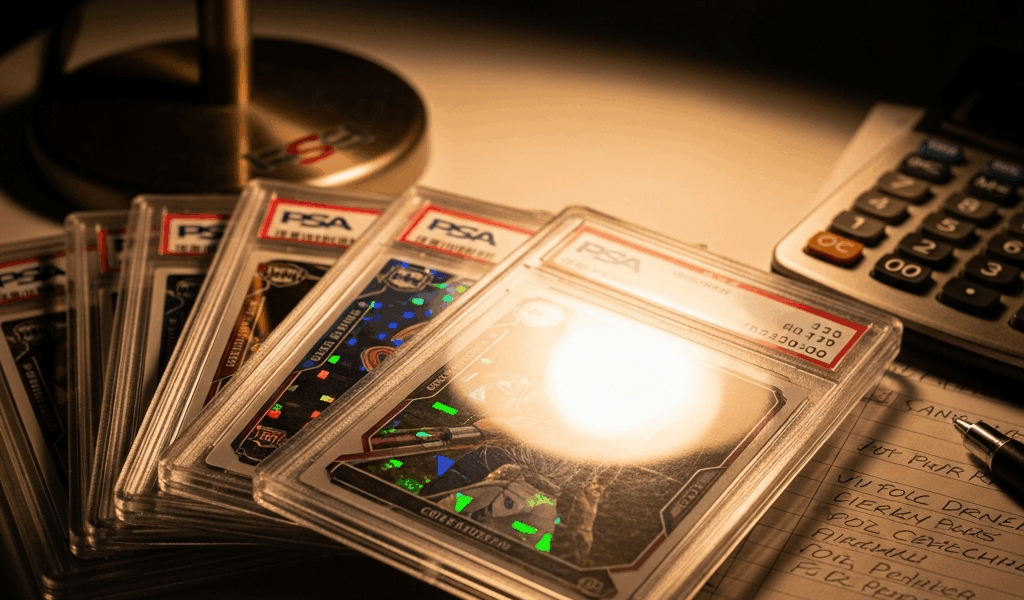
PSA Grading has gotten complicated with all the conflicting advice flying around.
As someone who has submitted over 400 cards to PSA across five years of obsessive tracking, I learned everything there is to know about whether grading actually pencils out financially. Today, I will share it all with you. Not the glossy stuff. The real numbers — including the losses, which honestly taught me more than the wins ever did.
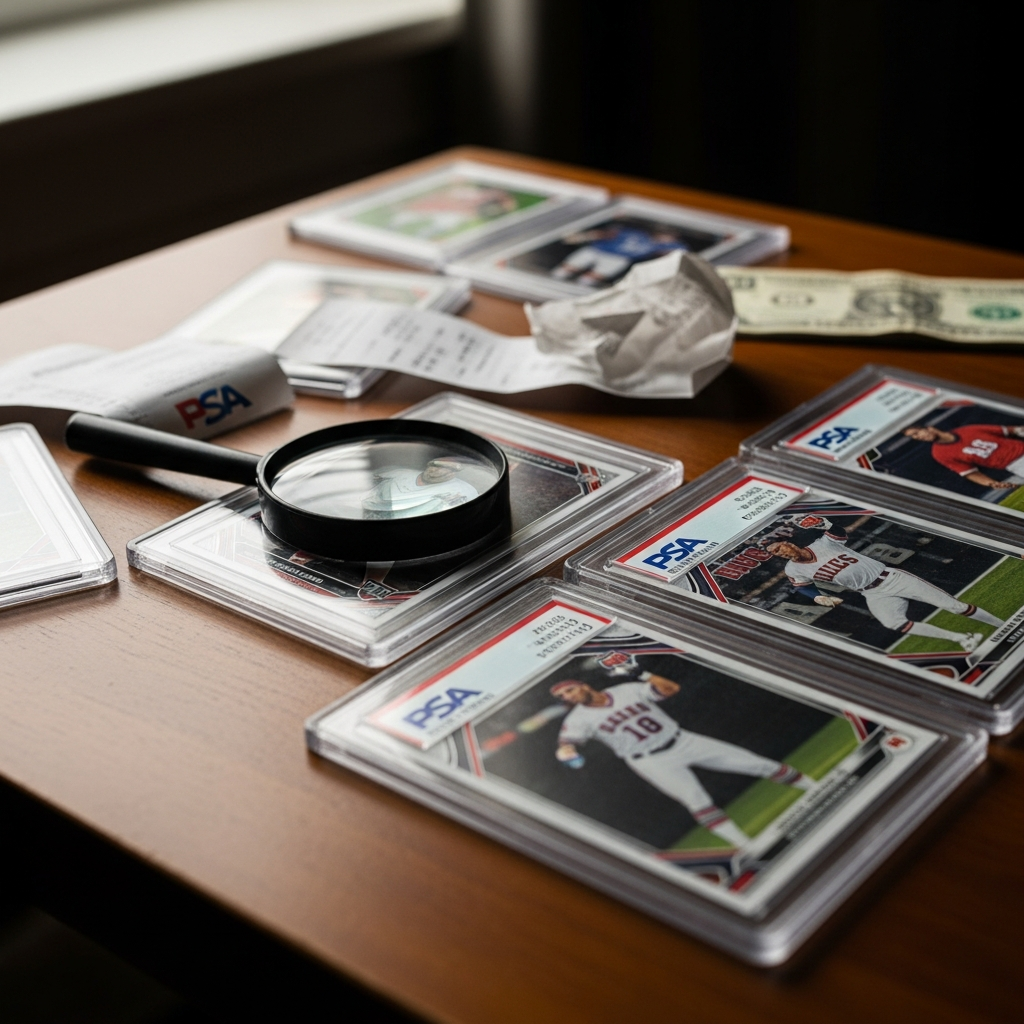
My wife finds my grading spreadsheet concerning. I find it essential. We’ve agreed to disagree.
The Math — When Grading Actually Adds Value
Let me start with raw economics. A raw card has a market value. PSA grading costs money. That friction point is where most people check out of the conversation too early.
Here’s a real example. I had a 1996 Topps Chrome Kobe Bryant rookie — genuinely nice condition, not perfect. I checked eBay sold listings obsessively for two weeks. Raw copies in comparable shape were moving for $22 to $28. No creases. No stains. Minor corner wear under magnification, but nothing dramatic.
PSA Standard service ran $20 per card at the time. Shipping with insurance: another $8. So I was already $28 deep before I even knew the grade. That card came back PSA 8. A comparable PSA 8 sold three weeks later for $87.
Net profit after grading costs, shipping, and PayPal’s 2.2% cut: $36. That’s a 129% return on the grading investment. But it took six weeks. And the timing cooperated. Don’t assume it always will.
That’s the game — at least when it works. The variables you need to actually run before submitting anything:
- Raw value right now — Sold listings, not asking prices. Never asking prices.
- PSA tier cost — Economy ($10), Standard ($20), Express ($75). Choose wrong and the math collapses immediately.
- Shipping and insurance — Budget $8 to $15 depending on declared value.
- Realistic grade expectation — Not what you hope. What PSA will actually give it.
- Graded premium — How much more does that specific grade sell for versus raw?
- Holding time — Six weeks minimum for Standard. Plan accordingly.
- Selling fees — eBay takes roughly 12.9% total. Factor that in before you get excited.
Probably should have opened with this section, honestly. The math kills most submissions before a single card gets packed up.
Here’s a failure example to balance the Kobe story. I once had a 2009 Topps Update Stephen Curry rookie — raw value around $15. Solid card. No visible defects. Standard grading: $20. Shipping: $10. Total in: $30. The card graded a 7. PSA 7 copies were selling for $31 to $38. After fees, I’d net maybe $8. I never submitted it. That decision saved me real money.
Break-Even Analysis — The Formula That Actually Works
But what is a proper grading calculator? In essence, it’s five questions you force yourself to answer honestly before touching a padded envelope. But it’s much more than that — it’s the thing that stops emotional decisions from eating your profits.
Frustrated by random submissions that kept losing money, I built mine in Google Sheets using nothing fancier than basic arithmetic. Here’s the framework:
- What is this card worth raw right now? Check the last 10 sold listings. Not current listings. Sold.
- What grade do you realistically expect? Grade yourself brutally first.
- What does that grade actually sell for? Again — sold listings. Last 10. Average them.
- Subtract grading cost. Subtract shipping. Subtract selling fees (assume 13% to be safe).
- Is the number positive? Is it more than 50% of your total cost basis?
If both answers aren’t yes, the card stays raw.
Vintage cards in exceptional condition pass this test regularly. A 1975 Topps George Brett in NM raw condition might fetch $40. That same card as a PSA 8 might move for $110. Grading runs $20 to $30. The math works — because raw vintage carries real uncertainty for buyers. Nobody knows if that card lived in a shoebox or a climate-controlled safe for 50 years. Authenticated grades eliminate that doubt, and collectors pay for the peace of mind.
Modern base cards almost never pass the test. A 2023 Bowman Chrome prospect who hasn’t cracked a Major League roster? PSA 10 might push a $12 raw card to $25. That’s not enough margin to absorb costs, risk, and a six-week wait.
Cards Worth Grading
After 400 submissions and a spreadsheet my wife has formally requested I stop expanding, here’s what actually works.
Flagship Rookies of Established Stars
Not prospects. Not “future stars.” Players with verified, sustained careers. A Luka Doncic 2018 Panini Prizm rookie in PSA 9 or 10 commands premiums that are real and stable — the market has fully priced in what he is as a player.
I learned this distinction the hard way. I submitted two Paolo Banchero rookies in 2022 — $8 raw each — expecting PSA grades to push them toward $20 or $25. They graded PSA 9 and PSA 8. I held them for a year. The market softened. The PSA 9 eventually sold for $18. Barely breakeven after fees. Don’t make my mistake.
Luka, Jayson Tatum, Trae Young — established guys with sustained demand. That’s where rookie grading actually holds up.
Vintage Cards in Genuinely Exceptional Condition
This is the category where I’ve hit the most consistent returns. A 1987 Donruss Mark McGwire rookie in PSA 9 condition — that’s real money. Raw vintage markets are thin and mistrustful. A 1980 Topps Joe Montana I submitted went from $35 raw to $110 graded. Costs were $25. Net after fees: roughly $50.
The condition threshold matters enormously here. If you’re squinting to decide whether a corner is soft, it’s probably a 7. If defects are obvious to your naked eye under decent light, don’t submit it.
Cards You’re Actually Going to Sell
Here’s the honest filter I use now — at least if you’re trying to make this a financially rational decision. If I’m keeping a card permanently, emotional attachment and all, I don’t grade it. The upfront cost and holding period don’t get compensated by a premium you never capture. But if you’re building inventory to sell, grading makes sense for the right pieces.
I run three tiers. Tier 1: permanent collection, never graded. Tier 2: potential sale candidates, graded selectively after running the math. Tier 3: bulk commons, not graded under any circumstances ever. That last category I learned by grading bulk commons. Once. Never again.
Cards NOT Worth Grading
This section matters more than the one above. Most cards live here.
Common Base Cards
A 2022 Topps Series 1 base card of a bench player. Nobody is paying a $15 premium for a PSA 10 of this card — the raw market barely exists. These move in bulk lots. Grading one individually is approximately the same as lighting a $20 bill on fire, except slower and with more shipping tape involved. I’ve done it. The lesson cost me $47 across three cards I submitted in 2021 when I clearly wasn’t thinking clearly.
Cards with Visible Defects
Creases. Stains. Off-center printing that you noticed immediately when you pulled it. Soft corners you can feel without a loupe. If a flaw is visible without magnification, don’t grade it. You’re looking at a 6 or 7 at best. The grading fee eats any theoretical value advantage completely. I submitted a card with a light crease once because I convinced myself it might still grade an 8. It graded a 6. That was $20 I will never emotionally recover from.
Cards You’re Keeping in Your Personal Collection
Honestly the toughest category to talk people out of — including past versions of myself. A raw card in a quality one-touch holder looks just as good on a shelf as a slabbed card. Same viewing experience. The premium only materializes if you’re selling, and if you’re not selling, you’ve just paid $30 to put a different plastic around something you already owned.
I’m apparently sentimental about a few slabbed cards in my personal collection and the PSA label works for me aesthetically while raw cards never feel quite the same in those specific display spots. But I do this knowing I’m paying for the look, not the investment. That’s a valid choice. It’s just not a financial one.
The honest number: 90% of cards are not worth grading. Margins too thin. Upfront costs too high. Time to profit too long.
What 400 Submissions Actually Taught Me
So, without further ado, let’s dive into the conclusions that actually stuck.
Condition assessment is everything — and most people are too optimistic about their own cards. A card you’re calling near-mint is often a 7 by PSA standards. I grade my own submissions brutally now, assuming PSA will find whatever I’m being generous about. If I’m squinting to give it a pass, I assume they won’t.
Timing the market is harder than the math suggests. A vintage card that checks every financial box can still sit for months if the market is soft when it comes back. I watch sold prices for at least two weeks before submitting anything over $50 in raw value. That’s not a perfect system — but it’s better than blind submission.
Modern cards might be the best option for getting excited about grading, as the premiums look appealing on paper. That is because the PSA 10 pop is relatively low on fresh releases. But modern card grading requires sustained player value that most prospects never deliver. Vintage is more reliable. That’s not nostalgia talking — it’s what my spreadsheet says.
Slab costs matter more than the hobby acknowledges loudly enough. If PSA Standard dropped to $10 flat, hundreds of mid-range cards would instantly clear the break-even threshold. The $20 to $30 entry point is the silent killer of otherwise reasonable submissions.
The practical answer here is simple. Calculate the math for your specific card. If potential profit doesn’t clear 50% of total costs, the card stays raw. If you’re keeping it, it stays raw. If you can’t identify current raw value within a narrow range using actual sold data — wait. You’re not ready to submit yet.
Grading adds real value for the right cards in the right conditions. That’s a genuinely small percentage of most collections. The better investment is patience, honest self-assessment, and selective submission. That’s what actually makes grading financially worthwhile instead of just financially optimistic.

Stay in the loop
Get the latest collector sports world updates delivered to your inbox.