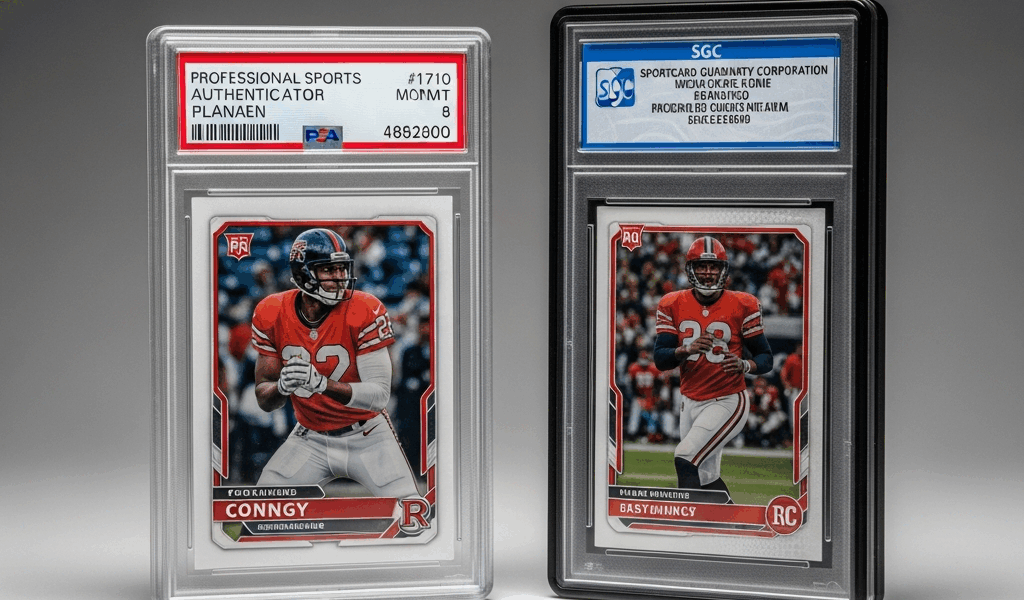
PSA vs SGC Grading — Which Service to Choose for Your Cards
The PSA vs SGC debate has gotten complicated with all the hot takes and half-baked comparison articles flying around. As someone who has shipped cards to both services — vintage tobacco cards, modern rookie slabs, everything in between — I learned everything there is to know about which label actually moves the needle at resale. And the answer isn’t what most people expect. It’s not one answer. It’s two. Which one applies to you depends almost entirely on what era you’re collecting. I wish someone had spelled that out before I dropped a 1963 Topps Sandy Koufax into a PSA submission and watched the vintage community basically shrug at it. Don’t make my mistake.
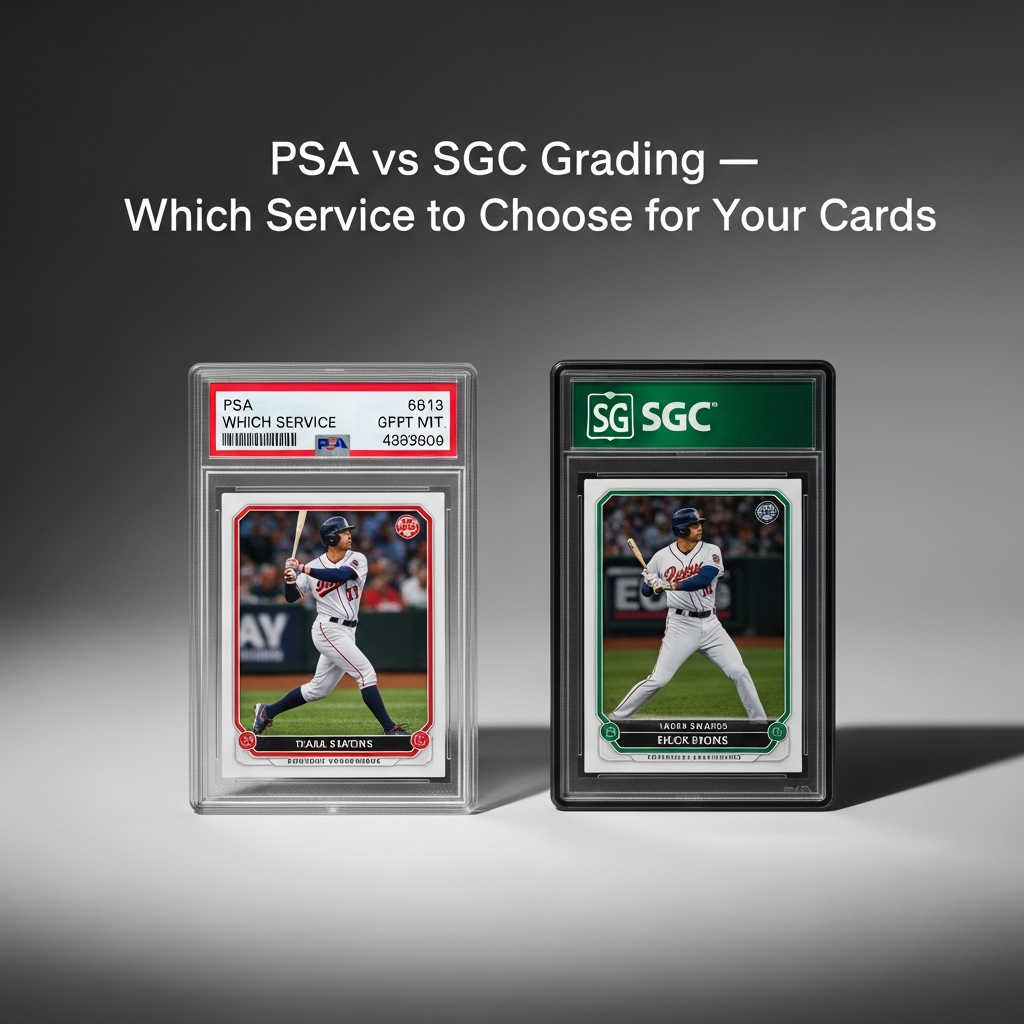
Both PSA and SGC are legitimate operations. Neither is running some elaborate slab scam. But the hobby has developed real, market-driven preferences for which label belongs on which cards — and ignoring those preferences costs actual money when you go to sell.
The Market Liquidity Split
Here’s what most comparison articles gloss over entirely: PSA and SGC don’t compete evenly across card categories. The market has already voted. Results split somewhere around 1970 — and that’s not an arbitrary line.
On modern cards — 2018 Topps Prizm, 2020 National Treasures, anything from the last decade of flagship releases — PSA 10s consistently command premiums that SGC 10s simply don’t touch. Pull up any active eBay listing for a 2020 Topps Chrome Ja Morant rookie right now. A PSA 10 moves for somewhere between $80 and $110 depending on the week. The same card in an SGC 10 typically lands between $45 and $65. That’s not a small gap. That’s a completely different conversation.
Burned by that Koufax experience, I started actually researching sold listings before submitting anything. What I found flipped my assumptions about SGC completely.
On pre-1970 vintage cards, the picture changes. SGC has built an enormous reputation in the vintage community — their newer snap cases are genuinely better at protecting brittle older card stock. A 1952 Topps Mickey Mantle in SGC 4 regularly trades at parity or better compared to a PSA 4. For tobacco-era cards from the T206 set, SGC is often the preferred label among serious vintage collectors. Not equally preferred. Actually preferred.
I watched a 1914 Cracker Jack Joe Jackson in SGC 3 sell for more than a comparable PSA 3 at auction. That’s the market telling you something directly. That’s what makes SGC endearing to us vintage collectors — it’s earned that trust over decades of specialization.
Why the Split Exists
SGC has been grading cards since 1998. They built their early reputation specifically on vintage material — pre-war stuff, tobacco cards, early postwar sets. PSA built dominance later, riding the modern rookie boom from the early 2000s through today. Registry sets. Population reports. The PSA brand became synonymous with liquidity in modern markets. Neither company did anything wrong. The market just evolved around their individual strengths, and here we are.
Cost and Turnaround Compared
Probably should have opened with this section, honestly. For a lot of collectors, the pricing question matters more than any abstract brand discussion ever could.
As of the most recent pricing I’ve checked — these change, so always verify directly on each company’s site before submitting anything — here’s how the common tiers break down:
PSA Submission Tiers
- Economy — $25 per card, estimated 100 business days. This is the tier most hobbyists use for cards valued under $500.
- Regular — $50 per card, estimated 45 business days.
- Express — $150 per card, estimated 10 business days.
- Super Express — $300 per card, estimated 5 business days.
- Walk-Through — $600 per card, same-day at shows or at PSA headquarters in Santa Ana, California.
SGC Submission Tiers
- Standard — $22 per card, estimated 30 business days.
- Express — $40 per card, estimated 10 business days.
- Super Express — $100 per card, estimated 5 business days.
- Premium — $250 per card, estimated 2 business days.
Those numbers tell a clear story. SGC is meaningfully cheaper at every comparable tier, and their standard turnaround beats PSA’s economy service by a significant margin. When I submitted a 20-card vintage lot to SGC Standard back in early 2023 — a mix of 1950s Topps baseball and a handful of Bowman football cards — the total bill came to $440 shipped back to me. Running those same cards through PSA Economy would have been $500 before return shipping, with roughly three times the wait. Not a close comparison.
For budget-conscious collectors, or anyone grading lower-value cards where the math has to work in your favor, SGC wins this section. No hedging needed — the pricing structure is just more accessible.
Where PSA’s pricing starts making sense is on high-value modern cards where the label premium at resale covers the submission cost and then some. If a card is worth $500 graded at PSA 10 and $300 graded at SGC 10, the $25 gap in submission cost is irrelevant. The $200 difference in expected sale price makes that decision for you.
Grading Standards Differences
This is where collector arguments get genuinely heated. I’ll be direct: the grading standards debate involves real differences — and a lot of perception that may or may not reflect reality, depending on who you ask.
The Half-Point System
But what is the half-point system, exactly? In essence, it’s SGC’s practice of awarding grades like 4.5, 7.5, or 8.5 — increments that PSA simply doesn’t offer. But it’s much more than that for vintage collectors. A card sitting right on the edge between a PSA 7 and 8 gets a definitive answer at SGC rather than a coin-flip. For vintage cards with imperfect centering or minor corner wear, that distinction matters quite a bit.
Modern collectors are largely indifferent — the market cares overwhelmingly about 9s and 10s, and the half-point system doesn’t do much at the top of the scale anyway.
Which Company Grades Stricter
Community perception says PSA grades stricter for 10s on modern cards. My personal experience — from maybe 80 or 90 combined submissions, so take this for what it’s worth — is that PSA 10s are harder to pull than SGC 10s on modern material, but not dramatically so.
The more meaningful difference is PSA’s population reports. They’re deeply embedded in how the hobby prices cards. A PSA 10 with a pop of 12 on a desirable rookie means something very specific to buyers. SGC’s population data is less widely referenced, which affects how the market prices scarcity. That’s a real disadvantage for SGC on the modern side — apparently the hobby just hasn’t made the switch to checking SGC pop reports with the same reflex.
Holder Quality
SGC’s current snap-lock holder might be the best option for vintage submissions, as the format requires minimal pressure on delicate card stock. That is because older cards — especially pre-war tobacco issues — are genuinely brittle, and PSA’s screw-down design has historically applied more pressure than ideal. SGC’s case is also easier to open if you ever want to crack it for a crossover submission, and the clear material doesn’t develop the slight yellow tint some older PSA holders picked up over the years.
For modern cards, this distinction matters less. You’re usually not cracking a 2022 Topps Chrome out of anything. I learned this distinction the hard way — cracked an old PSA holder once and caught the card edge on the plastic. Minor damage, major annoyance. I now default to SGC for anything I might want to resubmit later.
The Verdict
After going back and forth on this longer than any reasonable person should, here’s how I actually make the call before any submission.
Send It to PSA If
- The card is a modern rookie from a major flagship or chrome set — Topps Chrome, Prizm, Select, Optic
- You’re targeting maximum resale value and willing to pay the premium and absorb the longer wait
- The card is worth more than $200 graded at a 9 or 10, where the PSA label premium more than covers the submission cost difference
- You want the card on the PSA registry or care about population report visibility
- The card is post-1980 and from a major American sport
Send It to SGC If
- The card is pre-1970 — full stop, this is the clearest rule in my entire submission process
- You’re working with a budget and the card value doesn’t justify a $25 or $50 per card fee
- You need faster turnaround without paying PSA’s Express tier pricing
- The card is from the tobacco era, the pre-war era, or early postwar sets from the 1940s and 1950s
- You’re submitting a large lot of lower-value cards where the per-card cost compounds fast
The Cards That Could Go Either Way
The tricky middle ground is the 1970s and 1980s — Topps baseball from 1971 to 1985, early NBA cards, vintage football. Market preference here is genuinely less defined. I’ve started defaulting to SGC for anything pre-1980 and PSA for anything 1980 and after. Not a perfect rule — honestly, no rule covering this stretch really is — but it’s served me well enough as a starting point. Always check recent sold comps on eBay before committing. Thirty minutes of research before a submission beats months of regret after one.
One more thing worth saying plainly: both companies have had service issues, long backlogs, and grade disputes that left collectors furious. PSA paused new submissions entirely during the 2021 hobby boom and created a backlog that took over a year to clear. SGC had its own growing pains. Neither company is immune to a hobby that apparently tripled in participation seemingly overnight.
The PSA vs SGC question doesn’t have a universal right answer — but it does have a right answer for each specific card you’re holding. Match the service to the era, check the resale comps, and do the math on submission cost versus expected grade premium. That process, repeated consistently, is the difference between a collection that holds value and one that looks great on the shelf but sells for less than it should.



Stay in the loop
Get the latest collector sports world updates delivered to your inbox.